
Endometriosis: Symptoms, Diagnosis, Treatment and Fertility
Key Takeaways
Endometriosis is estimated to affect about 10% of women of reproductive age. A normal ultrasound does not exclude it. Not every endometrioma needs surgery, and endometriosis does not mean infertility. Hormonal treatments can reduce pain but do not treat infertility while you are trying to conceive. Under ESHRE 2022 and NICE 2024, diagnosis usually starts with imaging; routine endometrioma surgery before IVF has not been shown to improve live-birth rates.
Key evidence: ESHRE guideline: endometriosis (2022) WHO endometriosis fact sheet (2023) NICE NG73 — endometriosis (updated 2024)
What is endometriosis?
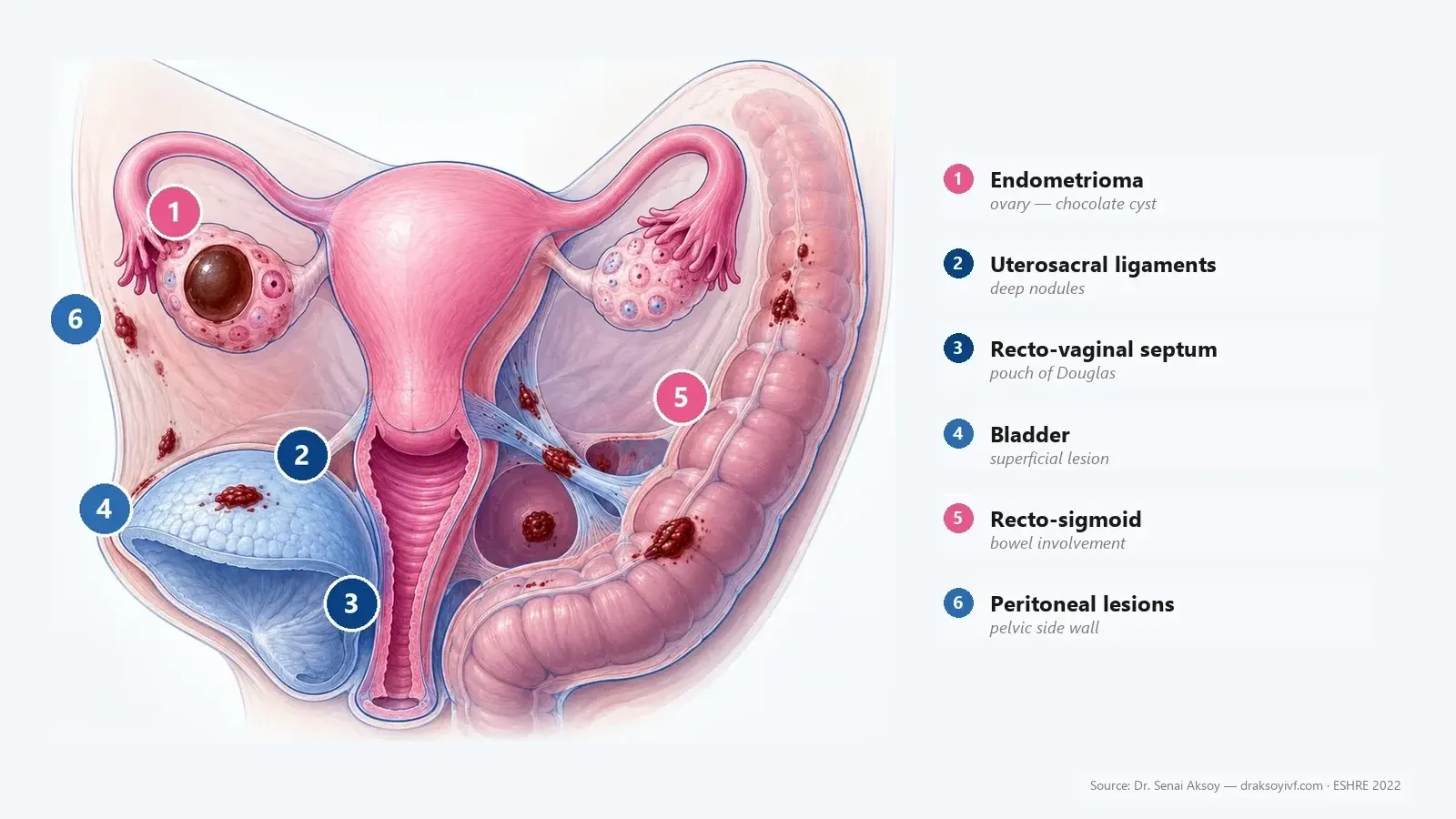
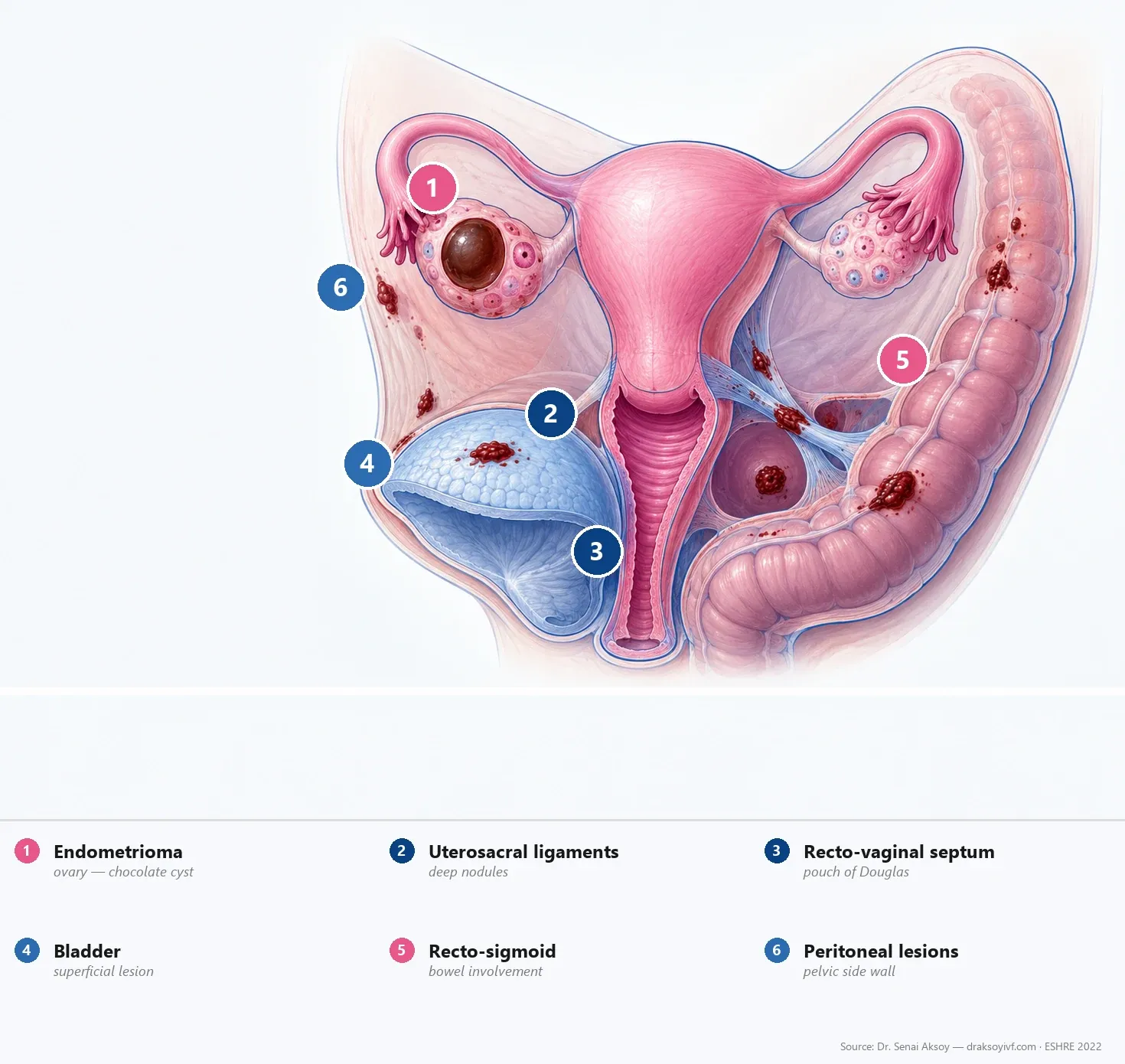
Endometriosis is a chronic inflammatory disease. Tissue similar to the lining of the uterus is found outside the womb — most often on the pelvic peritoneum, ovaries, ligaments, bowel or bladder, and sometimes farther away. It responds to estrogen. Over time, it can leave scarring and adhesions.
About 10% of women of reproductive age worldwide are thought to be affected — close to 190 million people, according to the WHO 2023 fact sheet. Published rates vary with how the diagnosis is made and who is studied. Studies that only count diagnoses already on record usually report lower figures.
This page is the full overview. For one topic at a time, see symptoms, diagnosis and ultrasound, pain treatment, endometriosis and infertility, endometrioma, and surgery. On fertility, you may also find these useful: ovarian stimulation, egg freezing, IVF success overview, and adenomyosis and IVF.
What matters most at the start:
- A normal ultrasound does not exclude endometriosis.
- Not every endometrioma needs an operation.
- Endometriosis does not mean infertility.
- Hormonal treatments can ease pain, but they do not improve fertility while you are taking them.
- Routine endometrioma surgery before IVF has not been shown to improve live-birth rates.
Day-to-day care is shaped by two guidelines: ESHRE 2022 and NICE NG73 (updated 2024). Imaging usually comes first. Laparoscopy is no longer an automatic first diagnostic step. Long “ultralong” courses of GnRH agonist before IVF are not recommended as routine care (Cochrane 2019).
If your priority is pregnancy, you are not on the same path as someone whose priority is pain control. That difference should guide every next step.
Endometriosis in numbers
The familiar ~10% figure for women of reproductive age remains the best population estimate for patients (WHO 2023).
Other rates look different because they measure different things. A systematic review by Parazzini et al., 2020 found pooled general-population estimates around 4.4%, about 23.8% in some surgical infertility series, and roughly half in some chronic-pelvic-pain surgical series — with wide confidence intervals. Those figures describe selected study groups. They are not one “true” rate for every reader.
Genetics matter as well. Genetic studies estimate heritability at around 50% (Rahmioglu et al., 2023). That figure describes how much of the variation in a population is genetic. It does not mean a mother has a 50% chance of passing endometriosis to her daughter. The same study found 42 risk regions in the genome. Some overlap with migraine, widespread pain, asthma and osteoarthritis.
Waiting for a diagnosis is still common. De Corte et al., BJOG 2025 reported delays from a few months to more than 12 years, depending on country and definition.
Pathophysiology: why endometriosis develops
No single theory explains every case. It is better to say so plainly when a patient asks, “Why me?”
Retrograde menstruation (Sampson’s idea) is one plausible mechanism: period blood flows back through the tubes into the pelvis. The process is common, yet only some women develop endometriosis. It may contribute. But it has not been shown to be necessary in every case, and it cannot explain the disease on its own.
Other hypotheses include coelomic metaplasia (cells changing type), embryonic Müllerian remnants, stem-cell spread, immune dysregulation, genetic risk, and local changes in the endometrium such as progesterone resistance. Microbiome research is still early. Routine gut or vaginal microbiome testing, antibiotics or probiotics cannot currently be recommended as endometriosis treatment.
Adenomyosis can sit alongside endometriosis, but it is not the same disease. It involves the uterine muscle wall and can change treatment and fertility planning on its own — see adenomyosis and IVF.
Classifications: understanding the stages
Doctors use three systems that complement each other. None of them maps how you feel day to day.
r-ASRM
This is the surgical score most people recognise. Stages I–II describe more limited superficial disease. Stages III–IV generally reflect more extensive disease, larger endometriomas and denser adhesions. Deep endometriosis may coexist at any stage and is not described well by the r-ASRM score. Stage often lines up poorly with pain or fertility.
#Enzian
#Enzian (2021) describes disease by anatomical compartment. It works on scans as well as on surgical findings. That makes it useful for mapping deep disease.
Endometriosis Fertility Index (EFI)
The EFI (Adamson & Pasta, 2010) combines your history with surgical findings. It helps estimate the chance of pregnancy without IVF after an operation. It is a conversation tool, not a switch that says “wait” or “go to IVF”. Age, ovarian reserve, how long you have been trying, the tubes, the semen analysis, past surgery and your priorities still decide the timing.
Symptoms
Symptoms vary widely. Some women have none.
Common clues include period pain that gets worse over time, pelvic pain between periods and deep pain during sex. Some women have pain opening their bowels or passing urine around the period. Others notice fatigue, bloating, cyclic rectal bleeding, blood in the urine or difficulty conceiving.
Endometriosis can reduce fertility — but not every woman with endometriosis is infertile, and many conceive without assisted treatment.
On examination, tender ligaments, nodules behind the uterus, a fixed retroverted uterus or an ovarian mass can support suspicion. A normal examination still does not exclude endometriosis.
Diagnosis: imaging first
This is the practical shift in ESHRE 2022, echoed by NICE in 2024. Start with imaging, not with laparoscopy by default. Our diagnosis guide goes into more detail.
A normal ultrasound does not exclude endometriosis.
Ultrasound is especially useful for ovarian endometriomas and many deep lesions. Superficial peritoneal endometriosis may be invisible. NICE still recommends offering ultrasound when endometriosis is suspected, even if the examination feels normal.
Transvaginal ultrasound (IDEA)
The IDEA protocol (Guerriero et al., 2016) gives the scan a structure: uterus and ovaries (including adenomyosis clues and endometriomas); soft markers; the sliding sign; then a search for deep nodules. Soft markers support suspicion; they are not specific. A free sliding sign does not rule out adhesions elsewhere.
Pelvic MRI
MRI helps when ultrasound is unclear, deep disease is suspected, or a surgical map is needed. It shares the same weakness for tiny superficial lesions.
CA-125
CA-125 is not a screening test. It cannot confirm or exclude endometriosis, and it is not used for routine monitoring. It may be part of a wider work-up for an unusual ovarian mass, but it is never read on its own.
Laparoscopy
Under ESHRE 2022, laparoscopy is no longer the default first diagnostic step. It is still useful when surgery is needed anyway. It also helps when symptoms continue despite normal scans and a trial of treatment has failed, is unsuitable or is declined (NICE 2024).
Ovarian endometrioma: operate or not?
An endometrioma — sometimes called a chocolate cyst — rarely has a one-size answer. Current guidance does not support a universal size cut-off for surgery (British Fertility Society ART recommendations, 2024).
Passing a certain size is not, by itself, a reason to operate. The decision weighs pain, the cyst’s appearance and growth, ovarian reserve and previous ovarian surgery. It also depends on whether one or both ovaries are involved, and whether the cyst blocks safe access to the follicles at egg collection.
Impact on ovarian reserve
Removing the cyst (cystectomy) can lower AMH. Meta-analyses consistently report an average fall in AMH after cystectomy, with a greater decline after bilateral or repeat surgery (Raffi et al., 2012; Somigliana et al., 2012). These are group averages. They cannot predict how much reserve one woman will lose. The risk is also higher when surgery removes more healthy ovarian tissue than necessary.
Before IVF: routine surgery has not been shown to improve live birth
ESHRE makes a strong recommendation here: do not remove an endometrioma routinely before IVF just to improve the live-birth rate. Hamdan et al., 2015 found no clear gain compared with leaving the cyst in place, while ovarian reserve may fall.
Dr. Aksoy’s approach before IVF
I do not operate on an endometrioma simply because it is there, or because it has passed a size threshold. Before IVF, I raise surgery mainly for four reasons: pain that cannot be controlled, concern about malignancy, harm to another organ (such as a blocked ureter or a narrowed bowel), or a cyst that stands in the way of safe egg collection.
To weigh that decision, I look at the pain, how the cyst looks on ultrasound and whether it is growing. I also check previous ovarian surgery, AMH, antral follicle count, and whether one or both ovaries are involved. When reserve is already low, avoiding unnecessary surgery matters. So does avoiding unnecessary delay.
Surgical technique when an operation is needed
When surgery is needed, the aim is complete and safe treatment that spares healthy ovarian tissue. That means avoiding excessive heat coagulation and controlling bleeding with as little ovarian damage as possible. For endometriomas, removing the cyst wall usually works better for pain and recurrence than draining and coagulating it. Its possible cost to ovarian reserve still belongs in the discussion.
Endometriosis and infertility
Several mechanisms may play a part: adhesions, distorted tubes, inflammation in the pelvis and lower ovarian reserve. Some studies also point to differences in oocyte or endometrial biology. Reserve may already be lower before any surgery (Muzii et al., 2018). How much molecular “receptivity” findings matter in the clinic is still unclear. They do not justify routine receptivity testing.
Hormonal suppression can reduce pain, but it does not improve spontaneous pregnancy rates while you are trying to conceive.
Pain care and fertility care are different pathways (NICE).
Wait or move to IVF?
How long to wait after surgery is not decided by stage or EFI alone. Age, ovarian reserve, how long you have been trying, the tubes, the semen analysis, past operations and your priorities are weighed together. EFI can support that conversation. It does not replace it.
When reserve is already clearly reduced, fertility planning should not be put off without a reason. This matters even more if another ovarian operation is planned. IVF or fertility preservation is then tailored to age, the expected number of eggs and the time available. A single AMH or follicle-count cut-off cannot choose the right strategy for everyone.
Long GnRH-agonist pretreatment before IVF
This is not recommended as a routine way to improve IVF results. Cochrane 2019 found very-low-quality evidence and no clear gain in live births. A GnRH agonist may still help control pain for some women. Easing pain is a different goal from improving IVF success.
Choice of IVF protocol
ESHRE does not mandate one ART protocol for endometriosis. Agonist and antagonist regimens can both be offered.
Freeze-all is not a routine step just because a woman has endometriosis. Freezing all embryos can make sense for reasons specific to the cycle: OHSS risk, an early rise in progesterone, an endometrial or medical problem, or planned genetic testing. Calling the disease “severe”, or feeling unsure about receptivity, is not enough on its own.
Fertility preservation
It is worth discussing when both ovaries are involved, only one ovary remains, ovarian surgery may be repeated, a young woman has extensive ovarian disease, or planned surgery clearly threatens reserve. Egg freezing is not mandatory for every endometrioma. Expected benefit depends on age and how many oocytes are likely to be collected — see how many eggs to freeze.
Low AMH on its own is not a reason for me to stop hormonal treatment that is controlling pain. AMH and follicle count mainly predict how many eggs stimulation may yield; age shapes what those eggs can do later. I raise egg or embryo freezing more actively when age is advancing, the follicle count is low or falling, endometriomas are on both sides or keep coming back, or there has been ovarian surgery or one is planned. In that last case, collecting eggs before the operation may be worth considering. We also talk openly about the number of eggs to expect and what freezing cannot promise. The possible benefits and limits of preservation are weighed for each woman (ESHRE 2022).
Pain management
The choice depends on how bad the pain is, your pregnancy plans, your other health issues and how well you tolerate treatment. Hormonal suppression treats pain, not infertility.
First-line options
Combined hormonal contraceptives and progestogens are both first-line choices in ESHRE 2022. Progestogens include dienogest and the levonorgestrel IUD. Simple painkillers or NSAIDs can help on difficult days. Dienogest is a well-studied option (Strowitzki et al., 2010); it is not a compulsory “step two after the pill” for every woman.
If first-line care is not enough
GnRH agonists usually come next. Where they are available and suitable, oral GnRH antagonists are another option. Both are given with add-back hormones to limit low-estrogen side effects and bone loss. NICE has assessed combinations such as relugolix–estradiol–norethisterone and linzagolix with add-back for some adults whose earlier medical or surgical treatment was not enough. Access, cost, side effects and pregnancy plans all matter.
Selected refractory cases
Aromatase inhibitors may be considered when pain resists other treatment (ESHRE 2022). They are usually combined with another hormonal treatment. Before menopause this use is off-label, and that should be explained clearly.
Supportive approaches
Pelvic-floor physiotherapy, psychological support, exercise or acupuncture may help some women cope with symptoms. This is most likely when the pelvic muscles are part of the pain. ESHRE does not make a specific recommendation for any of these, because the balance of benefit and harm is still unclear. They do not treat the lesions. They should not replace medical or surgical care when that care is needed.
Surgery: choosing the right technique
Excision or ablation for superficial disease
For pain reduction, excision may be considered when expertise allows. Evidence is limited and does not prove absolute superiority for every lesion (ESHRE 2022; Pundir et al., 2017; Healey et al., 2014). The technique should follow the lesion’s site and depth, the nearby organs and the surgeon’s experience. Excision provides tissue for the lab. Ablation may suit some situations.
Deep endometriosis
Deep disease involving bowel, bladder or ureters belongs in an experienced multidisciplinary centre with dedicated imaging.
In carefully chosen cases, shaving or discoid excision can cause fewer complications than removing a segment of bowel (Bendifallah et al., 2020). Large, multiple, narrowing or deeply invasive bowel lesions may still need segmental resection. Complication rates alone cannot pick the best technique for every patient.
Recurrence
Endometriosis can come back after surgery. A review of published series estimated recurrence at about 21.5% at two years and 40–50% at five years (Guo, 2009). Rates vary widely because “recurrence” can mean returning symptoms, new findings on a scan or a repeat operation. When pregnancy is not planned soon, hormonal treatment after surgery lowers the risk of recurrence (ESHRE 2022).
Endometriosis in adolescents
Endometriosis can begin with the first periods. Severe period pain, missed school or pain that does not respond to standard painkillers should raise the question early. Lesions may look red or vesicular rather than classically “pigmented.”
Early assessment and the right hormonal treatment can control pain and reduce disruption to school and daily life. But hormonal treatment has not been shown to protect future fertility or to stop the disease from progressing (ESHRE 2022). Surgery is kept for cases that do not respond, in expert hands. Fertility preservation may be discussed in some severe ovarian cases. Who benefits, and by how much, is still uncertain.
Turkish context
Turkish law does not allow egg, sperm or embryo donation, or surrogacy. Treatment in Turkey therefore uses the patient’s own eggs. When reserve is very low, whether treatment is still medically reasonable needs an individual assessment.
Practical takeaways
- Start with structured imaging; a normal scan does not exclude superficial disease.
- Do not use CA-125 to screen, confirm, exclude or routinely monitor.
- Do not operate every endometrioma — and not for a centimetre threshold alone.
- Before IVF, reserve surgery mainly for uncontrolled pain, concern about malignancy, organ compromise, or blocked follicular access.
- Hormones treat pain, not infertility while you are trying to conceive.
- First-line pain care includes combined contraceptives or progestogens; GnRH agents come later when needed.
- The surgical technique should fit the lesion and the team’s experience, not a fixed rule.
- Deep disease or complex fertility plans need a joined-up team discussion.
There is no single pathway that fits every woman.
FAQ
Can endometriosis be cured?
There is no definitive cure, but symptoms can often be controlled for long periods. Pregnancy is not a treatment. For some women, symptoms ease during pregnancy or after menopause. For others they stay the same, and less often they continue or get worse. In some women the disease stays active after menopause.
Can I have endometriosis even if my ultrasound and MRI are normal?
Yes. Expert ultrasound and MRI are useful for ovarian endometriomas and deep endometriosis, but superficial disease may remain invisible. Persistent symptoms should be assessed clinically rather than dismissed only because imaging looks normal.
Does every endometrioma need surgery before IVF?
No. Routine removal before IVF has not been shown to improve live-birth rates, and it can lower ovarian reserve (ESHRE 2022). Surgery stays an option for severe pain, suspected malignancy, harm to another organ, or a cyst that blocks safe egg collection. Size alone does not decide.
Which pain treatment fits which situation?
If you are not trying to conceive, first-line options are combined hormonal contraceptives or progestogens, with painkillers when needed. If these are not enough, GnRH agonists or, where available, oral GnRH antagonists with add-back can be discussed. The choice depends on your symptoms, your pregnancy plans and how well you tolerate each treatment.
Can IVF make endometriosis worse?
Current evidence does not show that ovarian stimulation for IVF increases the risk of endometriosis coming back (ESHRE 2022). The IVF plan is still tailored to your age, reserve, pain and the extent of disease.
What if my reserve is already very low?
Do not put off the fertility discussion, especially if more ovarian surgery is planned. Whether treatment is still medically reasonable, and which strategy with your own eggs fits best, needs an individual assessment. In Turkey, donation is not available.
What should I bring to the consultation?
Bring your ultrasound and MRI reports, operative notes and a list of current medicines. If fertility is a concern, AMH and antral follicle count results matter most; a full hormone panel is rarely needed just for the visit. A simple pain and cycle diary helps too, as does a semen analysis if you have one.
Sources
- Becker CM, Bokor A, Heikinheimo O, et al. ESHRE guideline: endometriosis. Human Reproduction Open 2022;2022(2):hoac009.
- National Institute for Health and Care Excellence. Endometriosis: diagnosis and management (NG73). Updated 2024.
- National Institute for Health and Care Excellence. Relugolix–estradiol–norethisterone for treating symptoms of endometriosis (TA1057). 2025.
- National Institute for Health and Care Excellence. Linzagolix for treating symptoms of endometriosis (TA1067). 2025.
- WHO. Endometriosis Fact Sheet, March 2023.
- Guerriero S, Condous G, van den Bosch T, et al. Systematic approach to sonographic evaluation of the pelvis in women with suspected endometriosis (IDEA consensus). Ultrasound Obstet Gynecol 2016;48:318–332.
- Parazzini F, Roncella E, Cipriani S, et al. The frequency of endometriosis in the general and selected populations: a systematic review. J Endometr Pelvic Pain Disord 2020;12(3–4):176–189.
- Rahmioglu N, Mortlock S, Ghiasi M, et al. The genetic basis of endometriosis and comorbidity with other pain and inflammatory conditions. Nat Genet 2023;55:423–436.
- Keckstein J, Saridogan E, Ulrich UA, et al. The #Enzian classification. Acta Obstet Gynecol Scand 2021;100:1165–1175.
- Adamson GD, Pasta DJ. Endometriosis fertility index. Fertil Steril 2010;94(5):1609–1615.
- De Corte P, Klinghardt M, von Stockum S, Heinemann K. Time to Diagnose Endometriosis. BJOG 2025;132:118–130. doi:10.1111/1471-0528.17973.
- Skorupskaite K, Hardy MF, Bhandari H, et al. Evidence based management of patients with endometriosis undergoing assisted conception: British Fertility Society policy and practice recommendations. Human Fertility 2024;27(1):2288634.
- Hamdan M, Dunselman G, Li TC, Cheong Y. The impact of endometrioma on IVF/ICSI outcomes. Hum Reprod Update 2015;21(6):809–825.
- Raffi F, Metwally M, Amer S. The impact of excision of ovarian endometrioma on ovarian reserve. J Clin Endocrinol Metab 2012;97(9):3146–3154.
- Somigliana E, Berlanda N, Benaglia L, et al. Surgical excision of endometriomas and ovarian reserve. Fertil Steril 2012;98(6):1531–1538.
- Muzii L, Di Tucci C, Di Feliciantonio M, et al. Antimüllerian hormone is reduced in the presence of ovarian endometriomas. Fertil Steril 2018;110(5):932–940.e1.
- Georgiou EX, Melo P, Baker PE, et al. Long-term GnRH agonist therapy before IVF for endometriosis. Cochrane Database Syst Rev 2019;CD013240.
- Pundir J, Omanwa K, Kovoor E, et al. Laparoscopic excision versus ablation for endometriosis-associated pain. J Minim Invasive Gynecol 2017;24(5):747–756.
- Guo SW. Recurrence of endometriosis and its control. Hum Reprod Update 2009;15(4):441–461. doi:10.1093/humupd/dmp007.
- Healey M, Cheng C, Kaur H. To excise or ablate endometriosis?. J Minim Invasive Gynecol 2014;21(6):999–1004.
- Bendifallah S, Vesale E, Daraï E, et al. Bowel-sparing techniques versus segmental resection. J Minim Invasive Gynecol 2020.
- Strowitzki T, Marr J, Gerlinger C, et al. Dienogest versus leuprolide for endometriosis pain. Hum Reprod 2010;25(3):633–641.
- Sanchez AM, Vanni VS, Bartiromo L, et al. Is the oocyte quality affected by endometriosis?. Hum Reprod Update 2017;23(5):600–622.
Add as a Preferred Source on Google
You can add draksoyivf.com as one of your preferred health information sources on Google.

The content has been created by Dr. Senai Aksoy and medically approved.