
Hyperprolactinemia: High Prolactin Levels in Women
Key Takeaways
A high prolactin result does not automatically mean that a prolactinoma is present. Testing is not routine for women with regular cycles and no suggestive symptoms. A moderate elevation should usually be repeated under suitable conditions and checked for macroprolactin. When treatment is needed, cabergoline is generally the first choice. A mild, stable elevation in a woman who ovulates regularly is not a proven cause of IVF failure and does not automatically need treatment.
Key evidence: ESHRE unexplained infertility guideline (2023) Pituitary Society prolactinoma consensus (2023) Systematic review of macroprolactinaemia prevalence (2020)
On this page
- What a high result means
- What level counts as high
- Do I need an MRI?
- Causes and testing
- Dr Aksoy’s perspective on borderline results
- The diagnostic workup
- Treatment options
- IVF and prolactin
- Pregnancy and prolactinoma
- Frequently asked questions for Dr. Aksoy
Receiving a high prolactin result can be unsettling, especially when it is only slightly above the laboratory range. The number alone does not establish a diagnosis.
The first question is usually not “Which treatment do I need?” It is “Is this result reliable, and does it fit the symptoms?”
What current guidance says about high prolactin
An elevated prolactin level needs clinical evaluation. One result does not prove pituitary disease.
Three points matter at the outset:
- For women with regular cycles and unexplained infertility, ESHRE guidance recommends against routine prolactin screening.
- When medication is needed, cabergoline is the preferred dopamine agonist in the Pituitary Society consensus.
- Macroprolactin accounts for about 19% of elevated results (Che Soh et al., 2020). Identifying it can spare a patient an unnecessary MRI or medication.
Prolactin: role and regulation
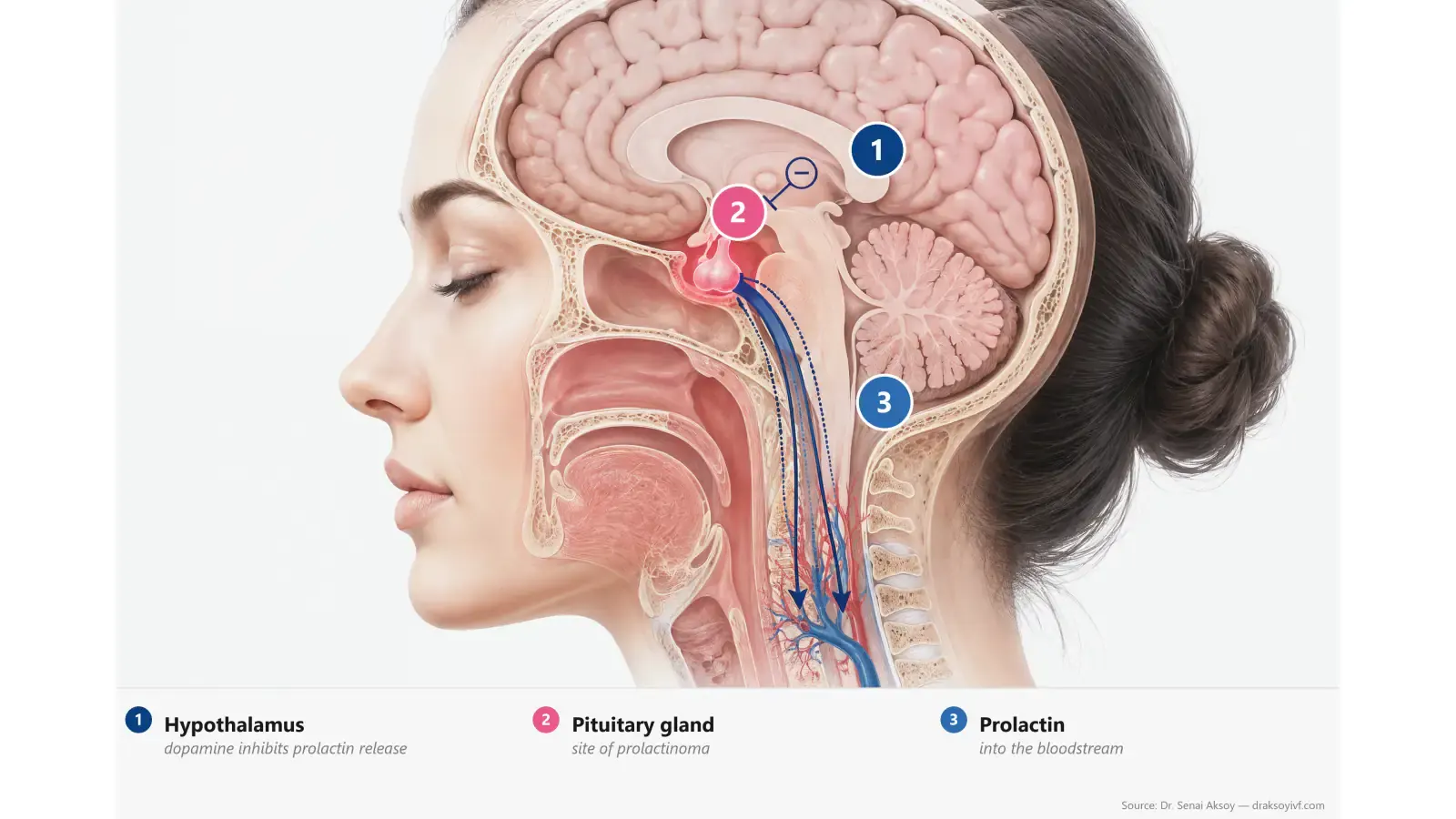
Prolactin is made by the anterior pituitary gland and supports milk production after birth. Outside pregnancy and breastfeeding, dopamine normally keeps its release under control.
Temporary rises can follow:
- Venipuncture stress during blood draw (2x to 4x rise).
- Nipple stimulation or recent sexual intercourse.
- Physical exercise, high-protein meals, or sleep disruption.
Hyperprolactinemia vs prolactinoma: not the same thing
- Hyperprolactinemia: A laboratory finding showing serum prolactin above normal reference ranges.
- Prolactinoma: A benign, prolactin-secreting pituitary tumour. A microprolactinoma is smaller than 10 mm. A macroprolactinoma is 10 mm or larger.
- Clinical guide: The Pituitary Society consensus notes that above 200 ng/mL a prolactinoma is more probable than other causes, but this level is not diagnostic by itself. Below this level, medicines, thyroid disease, sampling stress and macroprolactin also need to be considered before MRI is decided.
What prolactin level is considered high in women?
There is no single universal cut-off. A result is high when it is above the reference range of the laboratory that measured it, and these ranges differ between assays. What matters next is how high the value is and whether it persists.
- A result less than five times the upper limit of normal is usually repeated before further tests, because the stress of the blood draw alone can raise prolactin two- to fourfold for a short time (Pituitary Society, 2023).
- Above 200 ng/mL, a prolactinoma becomes more probable than other causes. The value is still interpreted together with pregnancy, medicines and symptoms; no single number establishes the diagnosis on its own.
Do I need an MRI for high prolactin?
Not after every mildly raised result. The first step is to confirm that the elevation persists and to look for pregnancy, prolactin-raising medicines, thyroid or kidney disease and macroprolactin. A pituitary MRI is generally considered when true hyperprolactinaemia remains unexplained after these checks, and sooner when headaches, visual changes or a marked, rising level suggest a pituitary lesion (Pituitary Society, 2023). For women taking antipsychotics, the consensus suggests MRI when prolactin is more than ten times the upper limit of normal, or when there are headaches, visual disturbance or other pituitary hormone deficiencies.
Causes of hyperprolactinemia
Physiological, medication and medical causes
- Physiological: Stress, exercise, pregnancy, breastfeeding, sleep.
- Medications: Antipsychotics (risperidone, haloperidol), prokinetics (metoclopramide), and certain SSRIs.
- Medical Conditions: Primary hypothyroidism (elevated TRH), chronic kidney disease, or liver cirrhosis.
- Macroprolactin: a larger, less active form of prolactin that can make the result look high; a laboratory test can separate it.
When should prolactin actually be tested?
Prolactin is not measured routinely in every fertility assessment. Testing becomes useful when cycle changes, symptoms, or the clinical context suggest a prolactin disorder.
The ESHRE 2023 Unexplained Infertility Guideline (Romualdi et al., Hum Reprod) explicitly recommends against routine prolactin testing in women with regular cycles and unexplained infertility.
A UK fertility-clinic cohort (Wojcik, Amer and Jayaprakasan, 2022) analysed 804 women attending for fertility treatment, 575 of whom were ovulating. Mostly mild elevations were not associated with a difference in ongoing pregnancy or live-birth rates. This was an observational study, so it cannot prove that every mild elevation is harmless.
Dr Aksoy’s approach
In an asymptomatic woman with regular cycles, I do not move to MRI or medication because of one mildly raised result. I first repeat the measurement under suitable conditions and exclude macroprolactin. If monomeric prolactin remains raised and pregnancy, medicines, thyroid disease and renal dysfunction do not explain it, I investigate the pituitary even when there are no symptoms.
I do not delay investigation when there is headache, a visual-field change, galactorrhoea, newly irregular cycles, or a marked and rising prolactin level. Treatment is supported when MRI shows a prolactinoma or when the excess prolactin is demonstrably affecting ovulation or oestrogen levels. Mild, stable true hyperprolactinaemia in a woman who ovulates regularly does not need to be driven to zero automatically before IVF.
A 2025 cross-sectional study also found that hyperprolactinaemia was no more common in women with PCOS than in controls. Most mild elevations in that study were explained by venepuncture stress or macroprolactin.
Prolactin testing is justified in these situations:
- irregular cycles, oligomenorrhoea or amenorrhoea,
- galactorrhoea (milky discharge outside breastfeeding),
- documented anovulation,
- headaches or visual changes suggesting a pituitary adenoma,
- polycystic ovary syndrome workup (prolactin is part of the differential per the 2023 International PCOS Guideline),
- women on antipsychotics or other prolactin-raising medications with hormonal symptoms.
For recurrent pregnancy loss, the 2026 ASRM Practice Committee opinion concludes that high-quality evidence linking prolactin disturbances to recurrent miscarriage is lacking.
It does not recommend routine testing unless symptoms such as galactorrhoea or anovulation are also present.
Symptoms of high prolactin in women
In women
The first signs are often cycle changes, absent ovulation or unexpected milk discharge rather than one dramatic symptom:
- Irregular or absent cycles (oligomenorrhoea, amenorrhoea).
- Anovulation and difficulty conceiving.
- Galactorrhea: spontaneous or expressed milky discharge outside breastfeeding.
- Decreased libido (sex drive), vaginal dryness, mood changes.
In men
- Decreased libido, erectile dysfunction.
- Possible changes in semen parameters (concentration, motility, morphology).
- Rarely, gynecomastia.
Symptoms related to a pituitary tumour
When a macroprolactinoma compresses nearby structures, persistent headaches and visual disturbances can appear. Visual-field narrowing may result from pressure on the optic chiasm, where the visual pathways cross.
Other pituitary hormone deficiencies may coexist and should be investigated.
Longer-term consequences
Sustained hyperprolactinaemia can lead to oestrogen or testosterone deficiency, with potential effects on bone health (demineralisation), mood, sleep and sexual function. These concerns belong in follow-up, even when the original problem was found on a blood test.
Mechanism: why prolactin blocks ovulation
Persistently high prolactin can interrupt the hormonal conversation between the brain and the ovaries. It dampens the signals from the hypothalamus that drive GnRH, and therefore FSH and LH, so ovulation can become irregular or stop and oestrogen levels may fall. Kisspeptin, a hypothalamic signal that stimulates GnRH, is one of the pathways involved (Pituitary Society, 2023).
This is why treating clinically significant hyperprolactinaemia often allows regular cycles and ovulation to return, although age and other fertility factors still matter.
Diagnosis: the practical workup
The result is confirmed first. Simple explanations are then checked before a pituitary MRI is considered. This sequence helps avoid medicalising a temporary rise.
1. Confirm the measurement
The Pituitary Society recommends repeating prolactin when the result is less than five times the upper limit of normal. For a mildly raised result, a repeat test under calm, rested conditions is usually more useful than acting on a single value. Follow the laboratory’s instructions and avoid strenuous exercise or nipple stimulation shortly before the test. If stress-related elevation remains a concern, samples taken through an indwelling cannula can help.
2. Rule out the obvious
- TSH to rule out hypothyroidism.
- Urea/creatinine and liver function tests as appropriate.
- β-hCG to rule out pregnancy.
- Full medication review.
- Test for macroprolactin (a laboratory test that separates this less active form) when prolactin is moderately elevated (below 200 ng/mL), at least when the result does not fit the symptoms or imaging, as the Pituitary Society recommends.
3. Pituitary MRI
A pituitary MRI is considered when hyperprolactinaemia is confirmed and remains unexplained; see Do I need an MRI for high prolactin?. The imaging protocol is selected by the clinical and radiology teams.
4. The hook effect: a pitfall to know
For very large adenomas, some assays can underestimate prolactin. This is an assay saturation effect known as the “hook effect.”
When a very large adenoma is seen but prolactin is only normal or mildly raised, the laboratory can repeat the assay after dilution to exclude this problem.
5. Visual field testing
Indicated when imaging shows the adenoma touches or compresses the optic chiasm. Monitoring during pregnancy is described in the pregnancy section.
Treatment: cabergoline first-line
When medication is indicated, cabergoline is generally the preferred first treatment. The cause, symptoms, and any pituitary finding still guide the plan.
Cabergoline
Cabergoline is the dopamine agonist recommended as first-line therapy by the Pituitary Society 2023 and the Endocrine Society. It mimics dopamine’s inhibitory action on prolactin.
- The dose is determined and adjusted by your doctor based on prolactin level, the presence and size of any prolactinoma, and individual tolerance. Treatment usually begins at a low dose, taken once or twice a week, and is gradually titrated.
- Tolerability is usually good; nausea, headache and postural dizziness are often transient. Persistent mood changes or unusual impulsive behaviours are less common but should also be reported.
- Ovulation often returns once prolactin is normalised. Pregnancy chances then depend on age and other fertility factors as well as prolactin.
The pivotal trial (Webster et al., NEJM 1994) found that cabergoline normalised prolactin in 83% of patients, compared with 59% with bromocriptine.
These trial figures describe a selected study population and should not be used to predict an individual’s chance of pregnancy.
Bromocriptine
Bromocriptine remains an option. It may suit patients who already tolerate it well or who need it in a particular pregnancy context.
It has a long history of use in pregnancy. Its tolerability was worse than cabergoline in the 1994 NEJM trial: 78% reported adverse events and 12% stopped treatment because of intolerance.
Quinagolide
Quinagolide is a non-ergot alternative useful in patients intolerant to cabergoline. It is not available in all countries.
Treating the underlying cause
- Hypothyroidism: thyroid hormone replacement can normalise prolactin on its own.
- Causative medication: the prescribing team evaluates adjustment or substitution, never abrupt discontinuation without specialist input.
- Chronic kidney disease or other chronic illness: management of the primary disease shapes the trajectory.
Cardiac surveillance: should you be concerned?
Ergot-derived dopamine agonists were linked to heart-valve disease at the high doses once used for Parkinson’s disease. The doses used for prolactin disorders are much lower, and the data at these doses are reassuring: a meta-analysis found more mild tricuspid regurgitation on echocardiography but no clinically significant valve disease (Stiles et al., 2018), and a large primary-care cohort found no excess heart failure or valve surgery (Stiles et al., 2021).
The Pituitary Society 2023 suggests an echocardiogram before long-term treatment above 2 mg of cabergoline per week, repeated every 2–3 years at that dose; at 2 mg per week or less, after 5–6 years. A new heart murmur warrants earlier assessment.
Surgery and radiotherapy
For a microprolactinoma, or a well-circumscribed macroprolactinoma that does not invade the surrounding structures, the Pituitary Society consensus recommends discussing transsphenoidal surgery (pituitary surgery performed through the nose) by an experienced pituitary surgeon alongside cabergoline as a first-line option. In this group, surgery offers a high chance of cure and avoids long-term medication; cabergoline remains the usual medical treatment. Results depend strongly on tumour size, extension and surgical expertise (Zamanipoor Najafabadi et al., 2020).
Surgery is also considered when:
- dopamine agonists are not tolerated or not effective,
- a predominantly cystic prolactinoma urgently compresses the optic chiasm (otherwise a dopamine agonist usually remains the first option),
- vision is deteriorating rapidly with a large tumour, or cerebrospinal fluid leaks from the nose,
- a woman with a macroprolactinoma is planning pregnancy: surgery before pregnancy reduces the risk of symptomatic tumour enlargement during pregnancy from 21% to 4.7% in the series cited by the consensus.
Radiotherapy is rarely needed; it is reserved for aggressive tumours or tumours that persist despite other approaches.
Resistance to medical therapy
Most prolactinomas respond to dopamine agonists. The Pituitary Society consensus defines resistance as prolactin that does not normalise, or a tumour that does not shrink by at least 30% in maximum diameter, after at least six months at standard doses (for cabergoline, 2 mg per week). Resistance is uncommon with cabergoline (Maiter, 2019); a specialist team may then adjust the dose, change medication or discuss surgery.
Hyperprolactinemia and IVF
A mild, symptom-free elevation does not automatically need treatment before IVF. A confirmed prolactin disorder that affects ovulation or reflects a prolactinoma is a different situation.
Should mild hyperprolactinemia be treated before IVF?
The available evidence, mainly from retrospective studies, does not support routine treatment of mild asymptomatic hyperprolactinaemia before IVF. Some series found no association with fertilisation, implantation or live birth, but their size and design limit certainty.
Transient elevations during ovarian stimulation
Increasing oestrogen during ovarian stimulation can cause a temporary rise in prolactin. The Iancu et al. 2023 review found that most studies did not link this transient rise to IVF outcome, although a few suggested that treating it might help; the evidence is limited and inconsistent. In my practice, a temporary stimulation-related rise does not, by itself, lead me to start a dopamine agonist.
Continuing treatment during stimulation
For a patient already receiving treatment, the plan depends on the adenoma and the pregnancy strategy. Cabergoline may be continued during stimulation and should be reassessed as soon as pregnancy is confirmed by the team managing the hyperprolactinaemia.
Cabergoline for OHSS prevention
This is a distinct indication. In patients at risk of ovarian hyperstimulation syndrome (OHSS), a short course of a dopamine agonist probably reduces moderate-to-severe OHSS. Effects on live birth, clinical pregnancy and miscarriage remain uncertain in the 2021 Cochrane review. Timing and duration depend on the IVF protocol.
Hyperprolactinemia, prolactinoma and pregnancy
Most microprolactinomas remain stable during pregnancy. Larger or invasive adenomas need an individual monitoring and treatment plan.
Tumor-growth risk during pregnancy
Pregnancy oestrogens can stimulate prolactinoma growth. The Pituitary Society consensus describes pregnancy as a risk factor for enlargement, especially for macroprolactinomas, and notes that the risk is higher without prior surgery. In the series it cites:
- Macroprolactinoma without prior surgery: about 21% risk of symptomatic enlargement.
- Macroprolactinoma operated on before pregnancy: about 4.7%.
Pituitary Society 2023 recommendations
- Microprolactinoma and non-invasive intrasellar macroprolactinoma: dopamine agonist is stopped at confirmation of pregnancy.
- Invasive macroprolactinoma or chiasmal proximity: continuing treatment through pregnancy may be considered; pre-conceptional debulking surgery is an alternative.
- Follow-up: clinical review about every 3 months for a microprolactinoma; for a macroprolactinoma, monthly review for symptoms and visual-field testing every 3 months.
- MRI without gadolinium: performed if new headaches or visual changes develop.
- Prolactin measurement is not informative during pregnancy (physiological elevation).
- Reintroduction of dopamine agonist to be considered for clinically significant adenoma growth.
Cabergoline safety in early pregnancy
Historical series have followed pregnancies that began during cabergoline treatment, for example 100 pregnancies reported by Lebbe et al. (2010).
The 2025 Chakraborty meta-analysis (12 studies, 1,387 pregnancies; PMID 40629810) compared continuing cabergoline during pregnancy with stopping it when pregnancy was diagnosed. It found no difference in congenital malformations, preterm birth or low birth weight. The 2025 Otis systematic review was also reassuring about malformations, but the studies were heterogeneous and generally of low quality.
In the meta-analysis, continuing cabergoline through pregnancy was associated with a lower live-birth rate (RR 0.81). This observational association does not establish that cabergoline caused the difference. Treatment should therefore not continue automatically after pregnancy is confirmed; the decision depends on adenoma size and clinical risk.
Bromocriptine has the longest history of use in pregnancy and remains an acceptable alternative, particularly when already well tolerated before pregnancy.
Breastfeeding
Breastfeeding is not contraindicated for a stable microprolactinoma or non-progressive macroprolactinoma. Dopamine agonists suppress lactation and are usually withheld during breastfeeding, except in case of tumour growth.
Before conception
Before conception, the aim is a stable prolactin level and the return of regular cycles. This helps with pregnancy dating and allows the treatment plan for a positive test to be agreed in advance.
Ovulation can return soon after a dopamine agonist is started, sometimes before the first period, so pregnancy can occur earlier than expected. For this reason the Pituitary Society consensus advises women who do not wish to become pregnant to use barrier contraception when treatment begins.
Quality of life and support
The impact is not limited to a laboratory value. Cycle changes, galactorrhoea, erectile difficulties, fatigue and changes in sexual wellbeing can affect confidence, relationships and the emotional experience of fertility treatment. These concerns deserve space in the consultation; psychological support can also help during a long fertility or IVF journey.
In practice
A high prolactin result is a signal to understand, not a diagnosis by itself. The most useful next step is often confirmation and a search for the cause rather than immediate treatment.
The practical points are:
- do not test prolactin routinely in every fertility assessment — test when symptoms or clinical signs suggest it,
- check for macroprolactin when prolactin is moderately elevated and symptoms are absent or discordant,
- cabergoline as first-line when medical treatment is indicated,
- stop treatment at confirmation of pregnancy for microadenomas and most non-invasive macroadenomas, with appropriate surveillance,
- do not treat stimulation-related transient prolactin rises or mild asymptomatic hyperprolactinemia before IVF.
Most cases respond well once the cause is identified. Fertility can return when prolactin is normalised.
Other infertility factors may still affect the outcome.
Frequently Asked Questions for Dr. Aksoy
Can high prolactin cause fatigue?
It can, but fatigue is not specific to high prolactin. Fatigue and difficulty concentrating are commonly reported, particularly by people with a prolactinoma. This may relate to prolactin itself, to lower oestrogen or testosterone, to changes in sleep and mood, or to treatment. That is why I do not attribute fatigue to prolactin alone; I also look at thyroid function, anaemia, sleep and other causes. In a large 2026 Dutch cohort of 450 women with a prolactinoma, fatigue was the most frequently reported complaint in both active and controlled disease (van Trigt et al., 2026).
Can high prolactin cause IVF failure or implantation problems?
Marked hyperprolactinaemia can impair natural fertility, because it can suppress ovulation and the reproductive hormones. But we cannot say that a mild or temporary rise during IVF is a proven cause of implantation failure. In most studies, temporary rises did not worsen IVF outcomes (Iancu et al., 2023). If there is true hyperprolactinaemia that needs treatment, I of course look for the cause and correct it. But I do not blame a mild prolactin elevation for every failed transfer.
What does high prolactin mean in a woman, and is it dangerous?
A single high result does not automatically mean a tumour. Stress, pregnancy, breastfeeding, hypothyroidism, some antidepressants and antipsychotics, other medicines, kidney or liver disease, and macroprolactin can all raise prolactin. A true, persistent elevation can cause irregular periods, milk discharge, low oestrogen, infertility and, in the long term, bone loss. Even when a prolactinoma is found, the great majority are benign pituitary adenomas, not cancer (Pituitary Society, 2023). With large tumours, headache or visual disturbance also need attention.
Can prolactin be lowered naturally, or is medication needed?
The first step is to find the cause. With a mild elevation, stress, lack of sleep or the conditions of the blood draw may play a role, so the test may need to be repeated under suitable conditions. However, there is no proven diet, vitamin or “natural” product that lowers prolactin from a prolactinoma. Hypothyroidism, if present, is treated; a responsible medicine is adjusted where appropriate. When a prolactinoma needs treatment, the first choice is usually a dopamine agonist such as cabergoline.
Is hyperprolactinaemia or a prolactinoma permanent, or can it go away completely?
It depends on the cause. Hyperprolactinaemia caused by a medicine or by hypothyroidism can resolve once the cause is removed. Prolactinomas are usually very well controlled with treatment: prolactin can return to normal and the tumour can shrink markedly. In some suitable patients, treatment can be stopped after at least two years of low-dose therapy with marked tumour shrinkage, and long-term remission is possible. But because recurrence is possible, follow-up does not stop. The 2023 Pituitary Society consensus also states that a withdrawal trial can be considered in suitable patients, with long-term prolactin monitoring afterwards.
Sources
- Petersenn S, Fleseriu M, Casanueva FF, et al. Diagnosis and management of prolactin-secreting pituitary adenomas: a Pituitary Society international Consensus Statement. Nat Rev Endocrinol 2023;19(12):722–740.
- Melmed S, Casanueva FF, Hoffman AR, et al. Diagnosis and Treatment of Hyperprolactinemia: An Endocrine Society Clinical Practice Guideline. J Clin Endocrinol Metab 2011;96(2):273–288.
- Romualdi D, Ata B, Bhattacharya S, et al. (ESHRE Guideline Group). Evidence-based guideline: unexplained infertility. Hum Reprod 2023;38(10):1881–1890.
- Teede HJ, Tay CT, Laven JSE, et al. Recommendations from the 2023 International Evidence-based Guideline for the Assessment and Management of Polycystic Ovary Syndrome. J Clin Endocrinol Metab 2023;108(10):2447–2469.
- Luque-Ramírez M, Quintero-Tobar A, Martínez-García MÁ, et al. Mild hyperprolactinemia in women with polycystic ovary syndrome: insights from a large cross-sectional study. J Clin Transl Endocrinol 2025;41:100412.
- Che Soh NAA, Yaacob NM, Omar J, et al. Global prevalence of macroprolactinemia among patients with hyperprolactinemia: a systematic review and meta-analysis. Int J Environ Res Public Health 2020;17(21):8199.
- Webster J, Piscitelli G, Polli A, et al. A comparison of cabergoline and bromocriptine in the treatment of hyperprolactinemic amenorrhea. N Engl J Med 1994;331:904–909.
- Stiles CE, Tetteh-Wayoe ET, Bestwick JP, et al. Meta-analysis of the prevalence of cardiac valvulopathy in patients with hyperprolactinemia treated with cabergoline. J Clin Endocrinol Metab 2019;104(2):523–538.
- Stiles CE, Lloyd G, Bhattacharyya S, et al. Incidence of cabergoline-associated valvulopathy in primary care patients with prolactinoma using hard cardiac endpoints. J Clin Endocrinol Metab 2021;106(2):e711–e720.
- Zamanipoor Najafabadi AH, Zandbergen IM, de Vries F, et al. Surgery as a viable alternative first-line treatment for prolactinoma patients: a systematic review and meta-analysis. J Clin Endocrinol Metab 2020;105(3):e32–e41.
- American Society for Reproductive Medicine Practice Committee. Recurrent pregnancy loss: a committee opinion. Fertil Steril 2026;125(6):1023–1041.
- Tang H, Mourad SM, Wang A, Zhai S-D, Hart RJ. Dopamine agonists for preventing ovarian hyperstimulation syndrome. Cochrane Database Syst Rev 2021;4:CD008605. doi:10.1002/14651858.CD008605.pub4.
- Lebbe M, Hubinont C, Bernard P, Maiter D. Outcome of 100 pregnancies initiated under treatment with cabergoline in hyperprolactinaemic women. Clin Endocrinol 2010;73(2):236–242.
- Otis AS, Brochet MS, Tremblay Z, et al. Cabergoline use and pregnancy outcomes: a systematic review. Birth Defects Res 2025;117(3):e2464.
- Chakraborty AM, Rastogi A. Safety of Cabergoline for Prolactinoma in Pregnancy: A Systematic Review and Meta-Analysis. Clin Endocrinol (Oxf) 2025;103(5):633–640. doi:10.1111/cen.15304.
- Wojcik M, Amer S, Jayaprakasan K. The prevalence of hyperprolactinaemia in subfertile ovulatory women and its impact on fertility treatment outcome. J Obstet Gynaecol 2022;42(6):2349–2353. doi:10.1080/01443615.2022.2049727.
- Maiter D. Management of Dopamine Agonist-Resistant Prolactinoma. Neuroendocrinology 2019;109(1):42–50.
- Iancu ME, Albu AI, Albu DN. Prolactin Relationship with Fertility and In Vitro Fertilization Outcomes—A Review of the Literature. Pharmaceuticals 2023;16(1):122. doi:10.3390/ph16010122.
- van Trigt VR, Pelsma ICM, Zandbergen IM, et al. The Dutch Prolactinoma Cohort Studies: cross-sectional analysis of females focusing on the patient’s perspective. J Clin Endocrinol Metab 2026. doi:10.1210/clinem/dgag331.
Add as a Preferred Source on Google
You can add draksoyivf.com as one of your preferred health information sources on Google.

The content has been created by Dr. Senai Aksoy and medically approved.