
Endometriosis and infertility: EFI, surgery, IVF and ovarian reserve
Key Takeaways
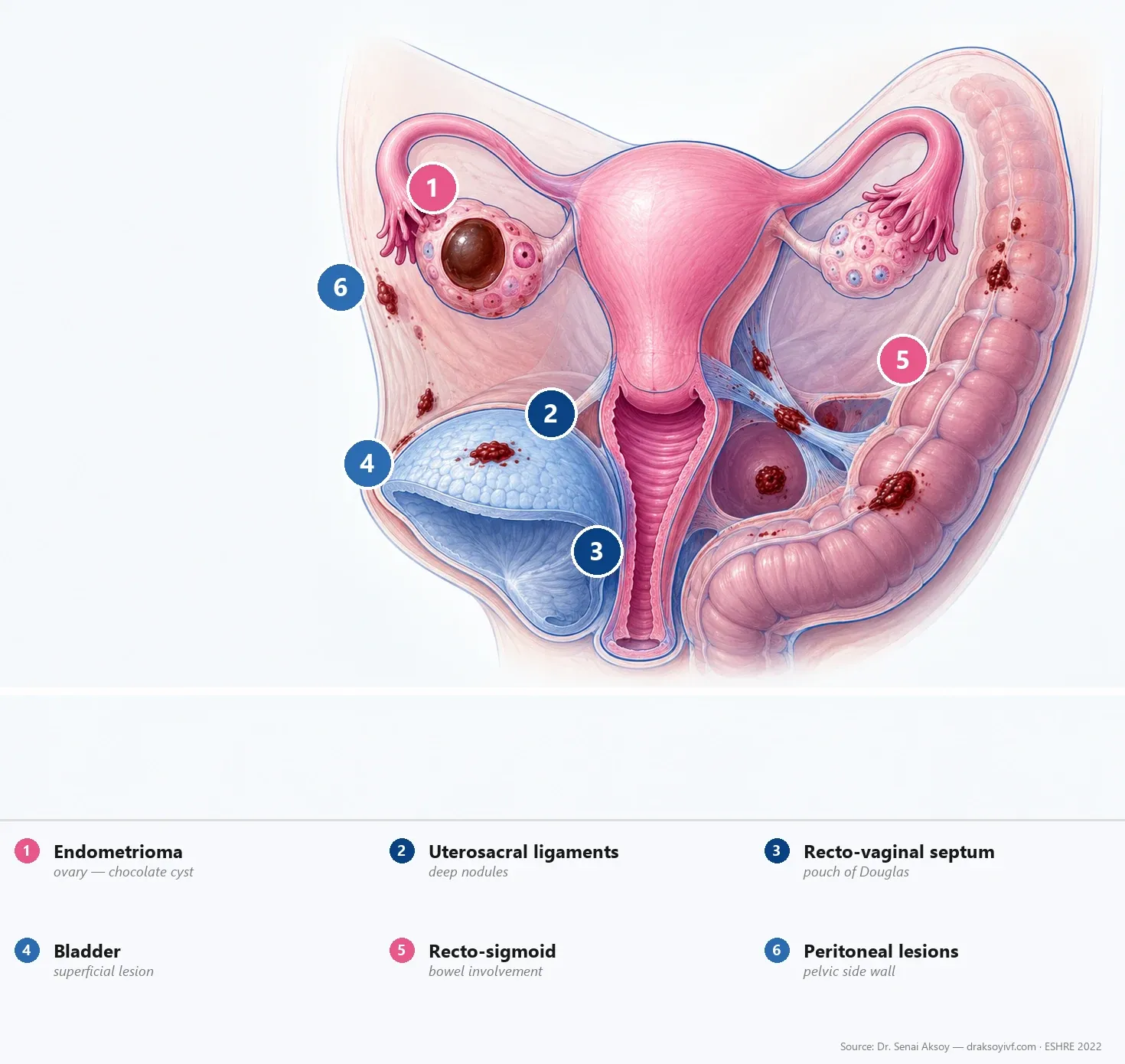
About one in four infertile women has endometriosis. The Endometriosis Fertility Index (EFI) helps decide between expectant management and direct IVF. Routine cystectomy before IVF is no longer recommended: it does not improve live birth rates and reduces ovarian reserve by about 30 % after a unilateral procedure and 44 % after a bilateral procedure. The long GnRH-agonist pre-treatment is no longer used routinely (Cochrane 2019). In Turkey, the ban on oocyte donation directs patients with severely diminished reserve to oocyte-sparing strategies (random-start, DuoStim, embryo accumulation).
How often is endometriosis the cause?
Endometriosis is found in about 23 to 50 % of infertile women across series. Conversely, 30 to 50 % of women with endometriosis experience infertility. The link is not mechanical: minimal endometriosis can be associated with significant infertility, and advanced endometriosis can be compatible with spontaneous pregnancy.
Management has changed substantially since ESHRE 2022 (Becker et al., Human Reproduction Open), with two major shifts: routine surgery for endometrioma before IVF is no longer recommended, and the GnRH-agonist ultra-long pre-treatment is no longer recommended either.
This article expands the fertility section of the complete endometriosis guide.
Why endometriosis reduces fertility
The mechanisms are multiple and co-exist:
- Anatomical distortion: adhesions, hydrosalpinx, fixed ovaries in stages III/IV — disrupting tubal pick-up of the oocyte.
- Pro-inflammatory peritoneal environment: cytokines (IL-6, IL-8, TNF-α) and reactive oxygen species impair gametes and early embryo development.
- Reduced oocyte quality: fewer mature oocytes, more meiotic spindle abnormalities (Sanchez et al., Human Reproduction Update 2017).
- Impaired endometrial receptivity: progesterone resistance of the eutopic endometrium, abnormal HOXA10/11 expression, integrin β3 dysregulation.
- Sometimes already diminished ovarian reserve before any surgery. The meta-analysis by Muzii et al., 2018 confirms that the endometrioma itself alters reserve, independent of any surgical procedure.
This biological complexity explains why no single intervention “fixes” fertility in endometriosis, and why the strategy must be individualised.
The EFI score: the decision tool
The Endometriosis Fertility Index (Adamson & Pasta 2010, Fertility & Sterility) is a validated score combining:
- historical factors: age, duration of infertility, prior pregnancy history;
- surgical factors observed at laparoscopy: least-function score of tubes, ovaries and fimbria — each scored separately;
- the r-ASRM score (lesions and adhesions).
The total ranges from 0 to 10. The higher the score, the better the prediction of spontaneous pregnancy after surgery.
Practical interpretation
- EFI ≥ 7: in stages III/IV, the unassisted live birth rate reaches around 60 % at 3 years and 75 % at 5 years. Expectant management after surgery is reasonable in younger women.
- EFI 5–6: shorter window of expectant management; intrauterine insemination if mild male or surmountable tubal factor.
- EFI ≤ 4: IVF proposed more rapidly.
The score is most useful after a laparoscopy. When the decision is taken without surgery (imaging + clinical picture), the trade-off between expectant management and IVF rests on age, ovarian reserve, duration of infertility, associated male or tubal factors, and imaging severity.
Ovarian surgery and reserve: what to know
Measured impact of cystectomy
Laparoscopic cystectomy of an endometrioma reduces ovarian reserve — and this is well documented.
- Meta-analysis by Raffi et al., 2012, J Clin Endocrinol Metab: weighted mean drop in AMH of −1.13 ng/mL (95 % CI −1.88 to −0.37), with about a 30 % decrease after unilateral cystectomy and 44 % after bilateral cystectomy.
- Somigliana et al., 2012, Fertility & Sterility: 9 of 11 studies confirm this drop.
- Risk of premature ovarian insufficiency of 2.4 to 13 % after bilateral cystectomy.
The drop reflects two mechanisms: inadvertent removal of healthy ovarian tissue adherent to the cyst wall, and thermal damage from the bipolar coagulation used for haemostasis.
Why surgery before IVF does not improve outcomes
The meta-analysis by Hamdan et al., 2015, Hum Reprod Update compared pre-IVF cystectomy with expectant management:
- Clinical pregnancy: OR 0.97 (95 % CI 0.78–1.20) — no difference.
- Live birth: OR 0.90 (95 % CI 0.63–1.28) — no difference.
- Response to stimulation: fewer follicles and fewer oocytes retrieved after surgery.
ESHRE 2022 accordingly issues a strong recommendation: routine cystectomy of endometrioma before IVF is not recommended.
When surgery remains a discussion
- Refractory pain not controlled by medical treatment.
- Suspicion of malignancy (atypical ultrasound features, rapid growth, aberrant markers).
- Large cyst obstructing follicle access at oocyte retrieval.
- Repeated infection or haemoperitoneum.
When surgery is indicated, several technical precautions limit reserve loss: minimal use of bipolar coagulation (suture, haemostatic agents), energy-sparing techniques (plasma energy or CO₂ laser for cyst-wall ablation when available), surgeon experienced in endometriosis.
GnRH-agonist pre-treatment: why it is no longer routine
For a long time, an “ultra-long” protocol of 3 to 6 months of GnRH-agonist before IVF was used, on the assumption that hormonal suppression might improve endometrial receptivity and oocyte quality in endometriosis patients.
The updated Cochrane review by Georgiou et al., 2019 reassessed this practice:
- the quality of the evidence was downgraded to “very low”;
- no clear benefit was confirmed for live birth or clinical pregnancy;
- the downsides (cost, artificial menopause, bone loss, treatment duration, delay to IVF) are real.
ESHRE 2022 issues a strong recommendation against this routine practice. It can be discussed case by case in patients with significant pain or particularly extensive disease, after complete information.
Choosing the IVF protocol in endometriosis
ESHRE 2022: “No specific assisted reproduction protocol can be recommended for women with endometriosis. GnRH-agonist and antagonist protocols can both be offered according to patient and clinician preferences, with no demonstrated difference in pregnancy or live birth rates.”
Several practical points:
- The antagonist protocol is often preferred for flexibility, shorter duration and lower risk of hyperstimulation, especially with diminished ovarian reserve.
- A frozen embryo transfer (freeze-all strategy) may be considered in selected situations (severe disease, hyperstimulation risk, suspected impaired endometrial receptivity), but should not be imposed routinely.
- Oocyte-sparing strategies are essential in low-reserve patients: random-start, DuoStim (two retrievals within one cycle), embryo accumulation across cycles before transfer.
- Fertility preservation (oocyte or embryo vitrification) should be discussed early, in particular before any ovarian surgery in a young patient without a current pregnancy plan.
Decision: expectant management or direct IVF?
The choice depends on stage, EFI, age, ovarian reserve and associated factors:
- Stage I/II + EFI ≥ 5–6 + woman < 35 years: 6 to 12 months of expectant management after confirmed surgery, with or without intrauterine insemination depending on male and tubal factors.
- Stage III/IV + EFI ≥ 7: 6 to 12 months of expectant management reasonable, IVF for patients who did not conceive.
- EFI ≤ 4 or age ≥ 35 or associated male/tubal factor: direct IVF.
- Severely diminished ovarian reserve (AMH < 0.5 ng/mL, AFC < 5): IVF without prior surgery, with sparing strategies.
The Turkish context: what changes for patients
Turkish regulations prohibit oocyte, sperm and embryo donation, and surrogacy. This constraint particularly affects patients with advanced endometriosis and severely diminished ovarian reserve, or repeated IVF failure: in Turkey, available strategies are limited to using the patient’s own oocytes.
Several approaches adapt to this constraint:
- Random-start protocols: stimulation can begin at any cycle phase — useful to save time or chain cycles.
- DuoStim: two stimulations and two retrievals within one cycle (follicular then luteal phase), to maximise oocyte yield.
- Embryo accumulation across several cycles before transfer, for very poor responders.
- Early fertility preservation when ovarian surgery is anticipated.
This information is communicated clearly during consultation so the patient can make an informed decision. Options abroad are mentioned for information, without active referral.
In practice
- Establish the diagnosis by imaging before any surgical decision (see diagnosing endometriosis).
- Assess ovarian reserve (AMH, AFC) before any surgical discussion, and preserve fertility if needed.
- Do not operate an endometrioma routinely before IVF; operate if pain, suspected malignancy or technical obstacle to retrieval.
- Do not prescribe a GnRH agonist as routine pre-IVF; case-by-case discussion only.
- Tailor the IVF protocol to ovarian reserve, age and preferences; antagonist often preferred.
- In Turkey, prioritise oocyte-sparing strategies for low-reserve patients.
FAQ
I have a 5 cm endometrioma and want IVF. Should I have surgery first?
Not automatically. Studies do not show improvement in live birth after pre-IVF cystectomy, and surgery reduces ovarian reserve. The discussion centres on associated pain, follicle access at retrieval, and possible suspicion of malignancy. Your doctor decides with you after imaging and a complete workup.
Why did my AMH drop after surgery?
Because cystectomy inadvertently removes healthy ovarian tissue adherent to the cyst wall, and the coagulation used for haemostasis can damage neighbouring follicles. The average drop is around 30 % after a unilateral cystectomy and 44 % after bilateral.
Is the “artificial menopause” ultra-long protocol still used?
No longer routinely. The 2019 Cochrane review and ESHRE 2022 do not support this practice for improving IVF outcomes. It can be discussed case by case for specific indications.
How long should I wait after endometriosis surgery before attempting IVF?
It depends on your EFI and your situation. For stages III/IV with EFI greater than 7, a 6 to 12-month window is reasonable because about 60 % of patients conceive spontaneously within 3 years. For lower EFI, advanced age or an associated male factor, IVF is proposed sooner.
What if my ovarian reserve is very low?
The goal becomes optimising each cycle: random-start, DuoStim, embryo accumulation. In Turkey, oocyte donation is not available, so oocyte-sparing strategy is essential. Fertility preservation should be considered early.
Will endometriosis get worse with IVF stimulation?
Stimulation exposes the patient to high oestrogen levels, which could in theory worsen lesions. Clinical data do not confirm a significant impact on the disease itself. The benefit of IVF almost always outweighs this theoretical risk in an infertile patient.
Will I need a diagnostic laparoscopy before IVF?
Not systematically. If imaging has already documented your disease and IVF is the agreed plan, purely diagnostic laparoscopy is not indicated. It remains useful when imaging is negative despite persistent symptoms, or for a therapeutic procedure (pain, deep involvement).
Sources
- Becker CM, Bokor A, Heikinheimo O, et al. ESHRE guideline: endometriosis. Human Reproduction Open 2022;2022(2):hoac009.
- Adamson GD, Pasta DJ. Endometriosis fertility index: the new, validated endometriosis staging system. Fertil Steril 2010;94(5):1609–1615.
- Hamdan M, Dunselman G, Li TC, Cheong Y. The impact of endometrioma on IVF/ICSI outcomes: a systematic review and meta-analysis. Hum Reprod Update 2015;21(6):809–825.
- Raffi F, Metwally M, Amer S. The impact of excision of ovarian endometrioma on ovarian reserve: a systematic review and meta-analysis. J Clin Endocrinol Metab 2012;97(9):3146–3154.
- Somigliana E, Berlanda N, Benaglia L, et al. Surgical excision of endometriomas and ovarian reserve: a systematic review on serum antimüllerian hormone level modifications. Fertil Steril 2012;98(6):1531–1538.
- Muzii L, Di Tucci C, Di Feliciantonio M, et al. Antimullerian hormone is reduced in the presence of ovarian endometriomas: a systematic review and meta-analysis. Fertil Steril 2018.
- Georgiou EX, Melo P, Baker PE, et al. Long-term GnRH agonist therapy before IVF for improving fertility outcomes in women with endometriosis. Cochrane Database Syst Rev 2019;CD013240.
- Sanchez AM, Vanni VS, Bartiromo L, et al. Is the oocyte quality affected by endometriosis? A review of the literature. Hum Reprod Update 2017;23(5):600–622.

The content has been created by Dr. Senai Aksoy and medically approved.