
Endometriosis and infertility: EFI, surgery, IVF and ovarian reserve
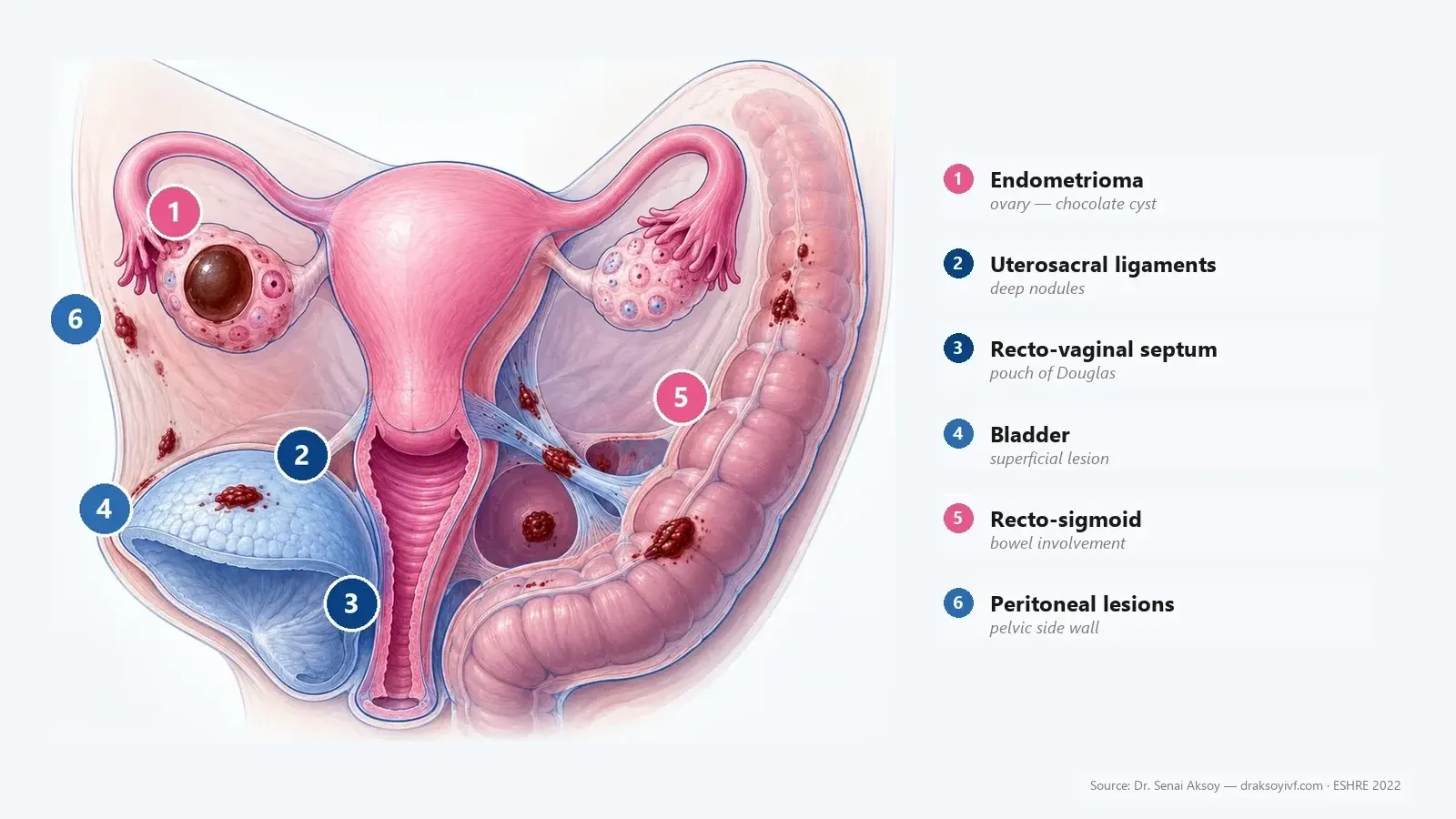
Key Takeaways
Endometriosis is common among women being assessed for infertility, but its effect on fertility varies widely. After surgery, the Endometriosis Fertility Index (EFI) can help estimate the chance of pregnancy without IVF. Routine endometrioma surgery or prolonged GnRH-agonist treatment before IVF is not recommended solely to improve live birth rates; decisions should also account for pain, ovarian reserve, follicle access, age and other infertility factors.
Key evidence: ESHRE guideline: endometriosis (2022) Endometriosis fertility index (EFI)
How often is endometriosis the cause?
Studies report endometriosis in 23% to 50% of women assessed for infertility. Conversely, an estimated 30% to 50% of women with endometriosis experience difficulty conceiving. These ranges vary with the population studied and how endometriosis is diagnosed.
Stage does not always correlate with fertility impact. Minimal disease can cause severe subfertility, while advanced disease is sometimes compatible with spontaneous conception.
Modern care per ESHRE 2022 guidelines reflects two key shifts:
- No routine pre-IVF cystectomy: Removing endometriomas before IVF does not increase live birth rates.
- No routine ultra-long GnRH suppression: Months of pre-IVF agonist therapy are no longer standard practice.
For a broader overview, see our complete endometriosis guide.
Why endometriosis reduces fertility
Endometriosis affects fertility through several coexisting mechanisms:
- Anatomical distortion: Adhesions and tubal blockage (stages III/IV) impair egg pick-up.
- Inflammatory microenvironment: Cytokines and oxidative stress may interfere with fertilisation and early embryo development.
- Reduced oocyte quality: Decreased mature egg yield and higher meiotic spindle abnormalities (Sanchez et al. 2017).
- Impaired receptivity: Progesterone resistance alters normal endometrial lining receptivity.
- Diminished ovarian reserve: Endometriomas themselves degrade surrounding ovarian tissue before any surgery occurs (Muzii et al. 2018).
The EFI score: the decision tool
The Endometriosis Fertility Index (EFI) (Adamson & Pasta 2010) is a validated clinical tool for estimating the chance of pregnancy without IVF after surgically documented and treated endometriosis. It cannot be calculated from symptoms or imaging alone.
The score (0 to 10) combines:
- Historical factors: Patient age, years of infertility, and previous pregnancy history.
- Surgical scores: Functional integrity of fallopian tubes, fimbriae, and ovaries.
- r-ASRM classification: Extent of pelvic lesions and adhesions.
Practical Interpretation
- Higher EFI scores: A higher chance of pregnancy without IVF may support a period of expectant management after surgery, depending on age and other fertility factors. In one cohort of women with stage III/IV disease and an EFI above 7, non-ART live birth reached about 60% at 3 years.
- Intermediate EFI scores: The time allowed for trying naturally or considering IUI is usually shorter and should reflect age, tubal function and semen analysis.
- Lower EFI scores: Earlier discussion of IVF may be appropriate, particularly when another infertility factor is present.
Ovarian surgery and reserve: what to know
Impact of Cystectomy on AMH
Laparoscopic cystectomy reduces ovarian reserve:
- AMH reduction: Raffi et al. (2012) showed an average 30% drop after unilateral cystectomy and 44% after bilateral cystectomy, a finding further confirmed across multiple series by Somigliana et al. (2012).
- Greater risk with bilateral or repeat surgery: The fall in ovarian reserve is less predictable and may be more pronounced when both ovaries are operated on or surgery is repeated.
Why Surgery Before IVF Does Not Improve Live Births
Meta-analysis by Hamdan et al. (2015) confirms:
- Clinical pregnancy: No significant improvement (OR 0.97).
- Live birth: No significant improvement (OR 0.90).
- Ovarian response: Fewer eggs retrieved after surgery.
ESHRE 2022 issues a strong recommendation against routine pre-IVF cystectomy.
Indications for Pre-IVF Surgery
- Refractory pelvic pain unresponsive to medical management.
- Suspicion of malignancy on imaging.
- A cyst that physically obstructs safe access to follicles during egg retrieval.
GnRH-agonist pre-treatment: why it is no longer routine
The historic “ultra-long” protocol (3–6 months of GnRH agonist suppression before IVF) is no longer routinely recommended.
The Cochrane Review by Georgiou et al. (2019) concluded:
- Evidence for live birth benefit is very low.
- Treatment can cause hypo-oestrogenic symptoms, affect bone density and delay IVF, while a live birth benefit remains uncertain.
Choosing the IVF protocol in endometriosis
ESHRE 2022 states that both GnRH-antagonist and GnRH-agonist protocols offer equivalent pregnancy rates.
Key protocol choices:
- Antagonist protocol: Often chosen for flexibility and a shorter treatment duration; it has not been shown to improve pregnancy or live birth rates specifically in endometriosis.
- Alternative stimulation timing: Random-start or double stimulation may be discussed in selected time-sensitive or poor-prognosis situations. Evidence is limited, and these approaches are not routine for everyone with low ovarian reserve.
- Fertility preservation: The potential benefits and limitations of egg or embryo freezing can be discussed before ovarian surgery, especially with bilateral disease or an already reduced reserve.
Decision: expectant management or direct IVF?
- After surgery with a favourable EFI: A limited period of trying naturally may be reasonable when age, tubal function and semen analysis are also favourable.
- With an intermediate EFI: The decision between a shorter period of trying, stimulated IUI and IVF depends on the wider fertility assessment.
- With a low EFI, increasing reproductive age or another infertility factor: IVF is usually discussed sooner.
- With markedly reduced ovarian reserve: Avoiding non-essential ovarian surgery and discussing the likely response to IVF may take priority. AMH or AFC alone does not determine the treatment.
The Turkish context: what changes for patients
Turkish health regulations prohibit egg, sperm, and embryo donation. Treatment must rely entirely on the patient’s own gametes.
For some patients with diminished reserve, options discussed may include:
- Random-start stimulation: Starting outside the conventional early-follicular window when time is limited and a fresh transfer is not planned.
- DuoStim (dual stimulation): Two retrievals in one menstrual cycle in selected cases; evidence for a live birth advantage remains limited.
- Embryo accumulation: Freezing embryos across more than one cycle before transfer, after discussing time, cost and the uncertain added benefit.
For international patients considering IVF in Turkey, these legal limits form part of the treatment discussion.
Clinical Note
When endometriosis is diagnosed in an infertile patient, our primary goal is to preserve ovarian reserve and shorten the time to pregnancy.
We avoid unnecessary diagnostic or pre-IVF surgery that could compromise follicle count without improving live birth rates.
Every protocol should be tailored based on age, AMH levels, symptoms, and previous treatment history.
Dr. Senai Aksoy
In practice
- Complete detailed imaging prior to any surgical decision.
- Check AMH and AFC to evaluate reserve before planning treatment.
- Avoid routine pre-IVF cystectomy unless pain or follicle access requires it.
- Avoid routine long GnRH suppression prior to IVF cycles.
- Discuss the stimulation approach individually; DuoStim and random-start are selected options, not routine solutions for low reserve.
For patients exploring IVF in Turkey for international patients, these endometriosis-specific protocol choices are discussed alongside the practical aspects of travelling for treatment.
FAQ
I have a 5 cm endometrioma and want IVF. Should I have surgery first?
Not automatically. Studies do not show improvement in live birth after pre-IVF cystectomy, and surgery reduces ovarian reserve.
The discussion centres on associated pain, follicle access at retrieval, and possible suspicion of malignancy. Your doctor decides with you after imaging and a complete workup.
Why did my AMH drop after surgery?
Because cystectomy inadvertently removes healthy ovarian tissue adherent to the cyst wall, and the coagulation used for haemostasis can damage neighbouring follicles. The average drop is around 30 % after a unilateral cystectomy and 44 % after bilateral cystectomy.
Is the “artificial menopause” ultra-long protocol still used?
No longer routinely. The 2019 Cochrane review and ESHRE 2022 do not support this practice for improving IVF outcomes. It can be discussed case by case for specific indications.
How long should I wait after endometriosis surgery before attempting IVF?
It depends on your EFI and the rest of your fertility assessment. In one cohort of women with stage III/IV disease and an EFI above 7, about 60% had a non-ART live birth within 3 years. That figure does not set a waiting time for everyone. Age, ovarian reserve, tubal function and semen analysis may justify discussing IVF sooner.
What if my ovarian reserve is very low?
The first step is to interpret AMH and AFC alongside age and the likely response to stimulation. Random-start, DuoStim or embryo accumulation may be discussed in selected cases, but none guarantees more usable embryos or a live birth. In Turkey, oocyte donation is not available, so avoiding unnecessary ovarian surgery can be particularly important.
Will endometriosis get worse with IVF stimulation?
Stimulation temporarily raises oestrogen levels, which can understandably cause concern. Available clinical evidence has not shown higher recurrence rates after ART, but symptoms and treatment goals still need individual review.
Will I need a diagnostic laparoscopy before IVF?
Not systematically. If imaging has already documented your disease and IVF is the agreed plan, purely diagnostic laparoscopy is not indicated. It remains useful when imaging is negative despite persistent symptoms, or for a therapeutic procedure (pain, deep involvement).
Sources
- Becker CM, Bokor A, Heikinheimo O, et al. ESHRE guideline: endometriosis. Human Reproduction Open 2022;2022(2):hoac009.
- Adamson GD, Pasta DJ. Endometriosis fertility index: the new, validated endometriosis staging system. Fertil Steril 2010;94(5):1609–1615.
- Garavaglia E, Pagliardini L, Tandoi I, et al. External validation of the endometriosis fertility index in women with stage III–IV endometriosis. Hum Reprod 2017;32(11):2243–2249.
- Hamdan M, Dunselman G, Li TC, Cheong Y. The impact of endometrioma on IVF/ICSI outcomes: a systematic review and meta-analysis. Hum Reprod Update 2015;21(6):809–825.
- Raffi F, Metwally M, Amer S. The impact of excision of ovarian endometrioma on ovarian reserve: a systematic review and meta-analysis. J Clin Endocrinol Metab 2012;97(9):3146–3154.
- Somigliana E, Berlanda N, Benaglia L, et al. Surgical excision of endometriomas and ovarian reserve: a systematic review on serum antimüllerian hormone level modifications. Fertil Steril 2012;98(6):1531–1538.
- Muzii L, Di Tucci C, Di Feliciantonio M, et al. Antimullerian hormone is reduced in the presence of ovarian endometriomas: a systematic review and meta-analysis. Fertil Steril 2018.
- Georgiou EX, Melo P, Baker PE, et al. Long-term GnRH agonist therapy before IVF for improving fertility outcomes in women with endometriosis. Cochrane Database Syst Rev 2019;CD013240.
- Sanchez AM, Vanni VS, Bartiromo L, et al. Is the oocyte quality affected by endometriosis? A review of the literature. Hum Reprod Update 2017;23(5):600–622.
Add as a Preferred Source on Google
You can add draksoyivf.com as one of your preferred health information sources on Google.

The content has been created by Dr. Senai Aksoy and medically approved.