
Can Isotretinoin (Accutane) Help Some Men With Non-Obstructive Azoospermia?
Key Takeaways
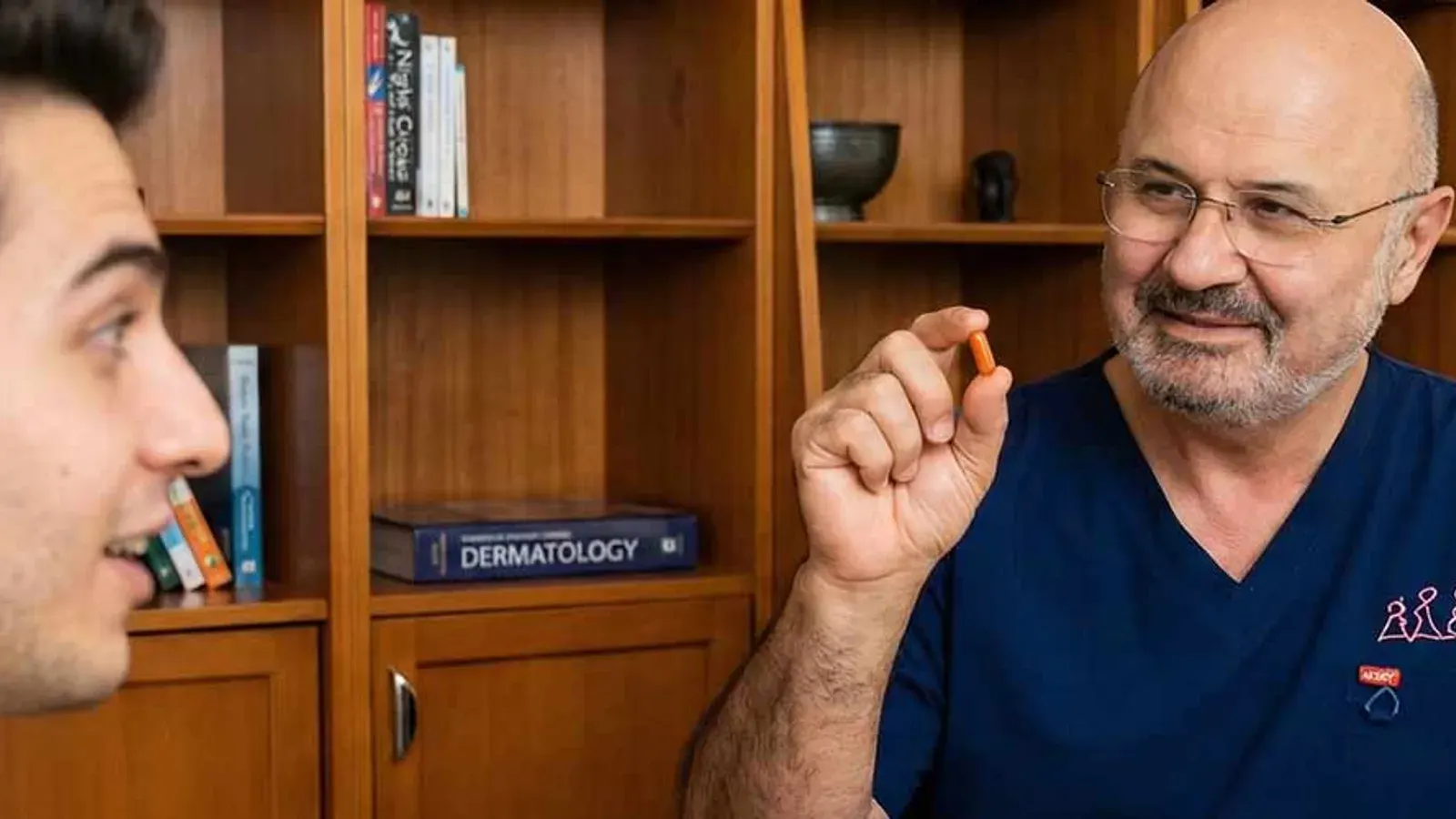
Isotretinoin is being investigated, off-label, for selected men with non-obstructive azoospermia. In one small 2025 study, motile sperm appeared in the ejaculate of 11 of 30 men (37%). Among men with maturation arrest, 6 of 11 responded. This approach needs specialist supervision. It is not a routine replacement for surgical sperm retrieval.
Key evidence: Jessup et al. (2025) Trial on Isotretinoin in NOA — J Assist Reprod Genet AUA/ASRM Guideline on Male Infertility Diagnosis and Management MotherToBaby (OTIS) Isotretinoin Fact Sheet
On this page
- Why is Isotretinoin Being Studied for Azoospermia?
- Video: Clinical Insights from Dr. Senai Aksoy
- The Biology: Retinoic Acid and Spermatogenesis
- Clinical Trial Evidence (Jessup et al., 2025)
- Histological Response: Who is Most Likely to Benefit?
- Treatment Protocol and Safety Monitoring
- Paternal Safety vs. Maternal Teratogenicity
- Frequently Asked Questions for Dr. Aksoy
- Sources
Why is Isotretinoin Being Studied for Azoospermia?
Isotretinoin, sold under brand names such as Accutane or Roaccutane, is an oral retinoid. Doctors mainly prescribe it for severe acne. Researchers are now also asking whether it could help some men with infertility.
In non-obstructive azoospermia (NOA), no sperm appear in the ejaculate because the testes make very few or none. Medical options for NOA are limited. One idea under study is that disrupted retinoic-acid signalling may stall sperm development in some men. It is still a hypothesis, not a confirmed explanation for every case.
Dr. Aksoy’s Approach
I do not regard isotretinoin as routine treatment for NOA. I may discuss it as an investigational option when existing biopsy or micro-TESE material shows germ cells with maturation arrest, particularly late arrest. A history of intermittent ejaculated sperm, cryptozoospermia or rare sperm found during a previous retrieval may also support that discussion once reversible hormonal causes have been addressed.
Sertoli-cell-only histology, extensive tubular sclerosis, absent germ cells or a complete AZFa or AZFb deletion make a response biologically unlikely. I would not perform a diagnostic testicular biopsy solely to decide whether to use isotretinoin. Nor would I delay micro-TESE–ICSI when the female partner’s age or ovarian reserve makes a three-to-six-month delay clinically important. If treatment is considered, the couple should understand that it remains off-label, does not guarantee sperm retrieval or live birth, and requires structured laboratory and mental-health monitoring—preferably within an ethics-approved study.
Video: Clinical Insights from Dr. Senai Aksoy
The video is in French. Subtitles and alternative audio tracks may be available in the YouTube player settings.
The Biology: Retinoic Acid and Spermatogenesis
Sperm production, called spermatogenesis, takes about 74 days in the human testis. Retinoic acid, an active form of vitamin A, helps control several key steps:
- Entry into meiosis: Retinoic acid switches on STRA8 (Stimulated by Retinoic Acid Gene 8). This lets early germ cells begin meiosis, the cell division that leads to sperm, and become primary spermatocytes.
- Remodelling the blood–testis barrier (BTB): Retinoid signalling in Sertoli cells helps organise the cycle of tight junctions that make up the barrier. Developing germ cells cross the barrier when these junctions are temporarily rebuilt around them.
- Spermiation: In mouse studies, retinoid signalling helps coordinate the final release of mature sperm from Sertoli cells into the seminiferous tubule.
If the enzymes that make retinoic acid (such as ALDH1A) fall out of balance with those that break it down (such as CYP26), retinoid signalling in the testis may drop. Researchers are still testing whether this plays a role in arrested sperm production.
Clinical Trial Evidence (Jessup et al., 2025)
A small prospective study of oral isotretinoin in men with severe infertility was published in the Journal of Assisted Reproduction and Genetics (Jessup et al., 2025):
- Participants: 30 men: 26 with non-obstructive azoospermia and 4 with cryptozoospermia (sperm found only occasionally, in very low numbers). Of the 26 azoospermic men, 92% (24 men) had already had a testicular sperm-retrieval procedure or fine-needle aspiration mapping.
- Treatment: Oral isotretinoin, 20 mg twice a day (40 mg a day), for 3 to 9 months.
- Main outcome (primary endpoint): Motile sperm in the ejaculate, in enough numbers for intracytoplasmic sperm injection (ICSI) or freezing.
- Overall result: Reliable numbers of motile sperm appeared in the ejaculate of 37% of participants (11 of 30) during treatment. In these responders, the ejaculated sperm could be used for ICSI.
Histological Response: Who is Most Likely to Benefit?
Testicular tissue can show whether germ cells are still present and able to keep maturing. In the small 2025 study, maturation arrest (germ cells stuck at one stage of development) was the only subgroup with a clearly reported response rate (Jessup et al., 2025). Six of the 11 men with maturation arrest responded (54%). Because the group is so small, this estimate is imprecise.
The study was too small to give reliable response rates for other patterns, such as hypospermatogenesis and Sertoli-cell-only syndrome. Without germ cells, a response is biologically less likely, but no rate has been measured.
Treatment Protocol and Safety Monitoring
Sperm need about 74 days to form, plus time to pass through the epididymis. That is why the study followed treatment for 3–9 months. This schedule was part of the research design, not a standard course for every patient.
- Baseline tests: Semen analysis (including a search of the centrifuged pellet), hormone levels (FSH, LH, total testosterone, prolactin, estradiol), karyotype, Y-chromosome microdeletion analysis, liver enzymes (ALT/AST) and a fasting lipid panel.
- Study dose: Participants took 20 mg twice daily. This was the research protocol, not advice for self-treatment.
- Monitoring: The prescribing clinician sets how often lipids, liver enzymes and side effects are checked, using the product information and the patient’s risk factors. Dry lips are common, but they do not show that sperm production has improved.
- Freezing sperm: Newly found motile sperm can be frozen promptly, so the sample is ready for a planned IVF-ICSI cycle.
Paternal Safety vs. Maternal Teratogenicity
Isotretinoin is a severe teratogen: when a pregnant woman takes it, it can cause serious birth defects. Because of this, many men worry that their own use could harm a future child.
The MotherToBaby isotretinoin fact sheet treats paternal exposure separately from the well-established risk of use during pregnancy. Current information suggests that a father’s exposure is generally unlikely to raise pregnancy risks. Direct data on men taking isotretinoin are still limited.
This does not make the drug risk-free. Men considering off-label treatment should discuss their plans for a child, possible sexual side effects and personal precautions with the prescribing clinician.
Frequently Asked Questions for Dr. Aksoy
Is isotretinoin (Accutane) an approved treatment for azoospermia?
No. Isotretinoin is mainly used for severe acne. It is not approved for azoospermia, which means no sperm are found in the semen. Retinoic acid, derived from vitamin A, plays an important role in starting and maintaining sperm production in the testes. Small studies have reported sperm returning to the semen after isotretinoin in some men with impaired sperm production.
I take these findings seriously, but we do not yet have evidence strong enough to say that isotretinoin should be used to treat azoospermia. First, we do not know which patients might benefit. Long-term safety and any effect on the chance of a live birth have not been studied enough either.
Isotretinoin is not a harmless drug. It can have important side effects, including changes in liver enzymes and blood fats. Today I do not regard it as a standard treatment for azoospermia. In selected men with impaired sperm production, though, I think it is an option that larger studies may assess in the future.
Does azoospermia prevent a man from having children?
Not necessarily. The biggest worry for men diagnosed with azoospermia is that they will never become fathers. Yet finding no sperm in the semen does not always mean there are none in the testes. I first try to find the cause.
In some men, sperm production is normal, but a blockage in the ducts stops sperm from reaching the semen. In these cases, sperm can be retrieved from the testis or the sperm ducts and used for IVF with ICSI, where one sperm is injected into an egg. Surgery to repair the blockage may also be possible in selected patients. In other men, the problem is sperm production itself; we call this non-obstructive azoospermia. Here, micro-TESE can be used to search for sperm inside the testicular tissue. These options are described in the AUA/ASRM treatment guideline.
Even in men with impaired production and no sperm in the semen, we may be able to retrieve sperm from the testis. But the chance depends on the cause, and retrieval does not succeed in every patient. That is why I do not make a final decision from a single semen test. I assess properly repeated semen analyses, hormones, examination findings and, when needed, genetic tests, as outlined in the AUA/ASRM evaluation guideline.
What I want my patients to understand is this: azoospermia is an important diagnosis, but it does not always mean that fatherhood is impossible. The deciding factor is why there is no sperm.
Is there a pill that can restore sperm production in azoospermia?
Medication can restart sperm production in some men, but no single pill works for everyone with azoospermia. For example, if the hormonal signal from the brain that starts sperm production in the testes is too weak, appropriate hormone treatment can bring sperm production back. These treatments are usually given as injections, and results can take months.
Sometimes high prolactin, testosterone medicines or anabolic steroids suppress sperm production. In these cases, correcting the underlying cause may allow production to restart.
The situation is different when the problem is a serious production disorder within the testis itself. Clomiphene and some other hormone-regulating medicines can be used in selected patients, but they have not been shown to restore sperm production in every man with azoospermia. Newer drugs such as isotretinoin are also being studied, but today they cannot be considered proven treatments.
I want to give one particular warning here. Taking testosterone on your own when you want to have a child can stop sperm production altogether rather than increase it. The AUA/ASRM treatment guideline describes this risk and the limits of medical treatment.
In a man with azoospermia, I first check whether there is a cause that hormones can correct. If there is, I treat it. If not, rather than giving months of medicines with uncertain benefit, I assess the chance of retrieving sperm from the testis. What matters to me is not giving the patient a medicine at all costs, but understanding why sperm production has stopped and choosing the treatment that can really help.
Related Reading
- Micro-TESE for Azoospermia: Indications, Success Rates, and Repeat Attempts
- Male Infertility Supplements: Scientific Evidence vs. Marketing Claims
- Varicocele Repair vs. IVF-ICSI: Choosing the Optimal Strategy
- Advanced Sperm Selection Techniques: IMSI, PICSI, and MACS
Sources
- Jessup CM, Amory JK, Turek PJ. Treatment with isotretinoin can improve de novo sperm production in nonobstructive azoospermia or cryptozoospermia. J Assist Reprod Genet. 2025;42(8):2793-2799. doi:10.1007/s10815-025-03567-6.
- Schlegel PN, et al. Diagnosis and treatment of infertility in men: AUA/ASRM guideline part I. Fertil Steril. 2021;115(1):54-61.
- Schlegel PN, et al. Diagnosis and treatment of infertility in men: AUA/ASRM guideline part II. Fertil Steril. 2021;115(1):62-69.
- Organization of Teratology Information Specialists (OTIS) / MotherToBaby. Isotretinoin (Accutane®).
Add as a Preferred Source on Google
You can add draksoyivf.com as one of your preferred health information sources on Google.

The content has been created by Dr. Senai Aksoy and medically approved.