
Micro-TESE for Azoospermia: Can a Second Attempt Work?

Key Takeaways
For many men with nonobstructive azoospermia, micro-TESE is the guideline-recommended sperm retrieval method because it can find sperm while limiting unnecessary tissue removal. If a first procedure does not find sperm, a repeat attempt may still be discussed in selected patients after a full hormonal, genetic, and surgical review—but redo success rates from published series should not be read as an individual prediction.
Key evidence: AUA/ASRM Guideline — male infertility (2024 update) EAU Guidelines on Sexual and Reproductive Health — Male Infertility (2026) Elbardisi 2025 — narrative review of redo micro-TESE after initial failure
Micro-TESE after a failed attempt: why hope remains — Dr Senai Aksoy
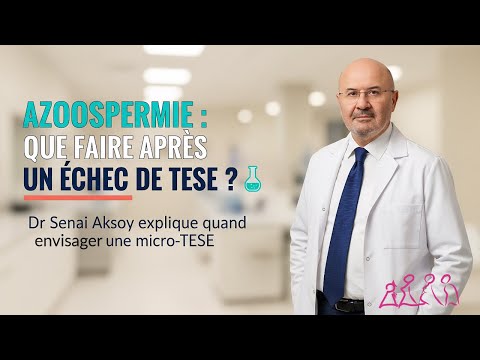
Video recorded in French; an English audio track is available in the YouTube player settings.
On this page
- Understanding azoospermia
- What micro-TESE does
- Why a second attempt may still help
- Factors that influence success
- How patients should prepare
- Frequently asked questions for Dr. Aksoy
- Clinical note
- Sources
Learning that a semen analysis shows no sperm can be difficult. However, it does not always rule out biological fatherhood.
In nonobstructive azoospermia (NOA), small focal areas of sperm production may remain within the testis. Micro-TESE uses an operating microscope to search for these hidden areas.
Understanding Azoospermia
Azoospermia means that no sperm are found in the ejaculate after the sample is centrifuged. At least two separate semen analyses are needed to confirm the diagnosis.
Azoospermia affects ~1% of all men and 10% to 15% of men evaluated for infertility.
Two distinct medical types exist:
- Obstructive Azoospermia (OA): Normal sperm production is present in the testis, but physical blockage prevents sperm release.
- Nonobstructive Azoospermia (NOA): Sperm production is severely impaired or confined to rare microscopic pockets.
What Micro-TESE Does
Micro-TESE stands for microsurgical testicular sperm extraction. During this operation, the surgeon examines testicular tissue under a microscope and takes small samples from selected areas.
Key aspects of micro-TESE:
- Microscopic search: The surgeon inspects individual sperm-producing tubules under 20–25× magnification. Larger, more opaque tubules are selected for laboratory assessment.
- Guideline recommendation: Both the 2024 AUA/ASRM guidelines and the EAU Male Infertility guidelines recommend micro-TESE over conventional TESE for NOA cases.
- Targeted sampling: In a meta-analysis of observational studies, micro-TESE retrieved sperm more often than conventional TESE, which in turn did better than needle aspiration (Bernie et al., 2015); its targeted approach also aims to remove less tissue.
- Hormonal follow-up: Testosterone levels can fall temporarily after surgery, so endocrine monitoring may be considered if symptoms of hypogonadism or low testosterone develop.
For treatment costs, see our cost of IVF in Istanbul breakdown.
Why a Second Attempt May Still Help
An unsuccessful first micro-TESE does not mean that every option is exhausted. A repeat procedure may be discussed after reviewing the first operation, embryology search records, pathology slides, and genetic results.
Key findings on repeat micro-TESE:
- Redo retrieval rates: A narrative review of nine redo series (four retrospective, five prospective) reports sperm retrieval rates of 10% to 21% in most series, with one series reaching 42% (Elbardisi et al. 2025). Other figures are wider: the EAU guideline reports 18.4% to 42.8% for salvage micro-TESE after a failed micro-TESE (EAU guidelines), and a 2025 series found sperm in 28.8% of repeat procedures (Alriyalat et al. 2025). None of these is an individual prediction.
- Favorable subgroups: Patients with hypospermatogenesis or Klinefelter syndrome show higher redo retrieval rates.
- Genetic contraindications: With complete AZFa or AZFb Y-chromosome microdeletions, the chance of finding sperm is almost zero. The EAU Male Infertility guidelines explicitly advise against TESE in these cases. AZFc deletions have a different, variable outlook, and genetic counselling is needed because any sons will inherit the deletion (EAU guidelines).
Factors That Influence Success
- Testicular histopathology: Hypospermatogenesis offers better retrieval odds than maturation arrest or Sertoli-cell-only pattern (EAU guidelines).
- Y-chromosome microdeletions: AZF testing clarifies whether repeat surgery is medically indicated or contraindicated.
- Hormone evaluation & pre-op stimulation: FSH and testosterone reflect testicular function, though the EAU guideline advises against treating preoperative hormone and clinical findings as sufficient and reliable predictors of retrieval (EAU guidelines). Routine hormonal stimulation before redo micro-TESE is not recommended by EAU guidelines due to lack of proven benefit.
- Surgical interval: Published redo series report intervals ranging from 6 to 24 months between procedures (Elbardisi et al. 2025), though no single waiting period is universally established.
How Patients Should Prepare
- Hormone review: Check testosterone, FSH, and LH levels. Any treatment decision should follow a specialist assessment.
- Genetic testing: Verify karyotype and Y-chromosome microdeletion testing (AZF panel).
- Previous records: Review the first operative report and testicular biopsy slides.
- Laboratory plan: Confirm that the embryology team is ready to search for and freeze any sperm found.
- Counselling: Discuss the limits of a repeat attempt and available alternatives.
Fresh or frozen testicular sperm can both be used for ICSI (AUA/ASRM guideline). Older meta-analyses found no difference in pregnancy outcomes (Ohlander et al., 2014; Yu et al., 2018), while the largest and most recent one (36 studies, 5,086 ICSI cycles) found slightly higher fertilisation and live-birth rates with fresh sperm, with similar implantation and clinical pregnancy rates (Senel et al., 2026).
Exogenous testosterone should not be used while fertility is still a goal. The AUA/ASRM guideline advises against prescribing it to men interested in current or future fertility (AUA/ASRM guideline), and the EAU guideline states that testosterone therapy is contraindicated in infertile men (EAU guidelines). Testosterone given from outside can suppress the pituitary hormones FSH and LH that drive sperm production.
Frequently Asked Questions for Dr. Aksoy
What is the chance of finding sperm with micro-TESE, and what affects it most?
In nonobstructive azoospermia, micro-TESE finds sperm in roughly 45–50% of men overall, but this varies greatly from one patient to another. The most important factors are the underlying cause, the genetic findings and whether there really is focal sperm production in the testis. With a complete AZFa or AZFb deletion, for example, there is practically no chance of finding sperm. A high FSH or the testicular volume can give an indication, but neither is reliable enough on its own to say whether sperm will be found; when histology shows hypospermatogenesis the chance is higher, and with a Sertoli-cell-only pattern or some forms of maturation arrest it is lower.
For reference, a large meta-analysis of 117 studies found sperm in 47% of TESE procedures overall (95% CI 45–49%), with no clear difference between micro-TESE and conventional TESE (Corona et al., 2019); case-control studies that compared the two techniques directly, cited by the EAU guideline, found 52% versus 35%. The EAU guideline also advises against treating preoperative hormone and clinical findings as sufficient predictors on their own (EAU guidelines).
If no sperm are found at micro-TESE, what are the next options?
First I review the diagnosis and the procedure itself: is this really nonobstructive azoospermia, is there a correctable hormonal or medication-related cause, is the genetic work-up complete, and was the first operation performed by an experienced micro-TESE team? If the first procedure was a conventional TESE, sperm can still be found with a salvage micro-TESE. If the first micro-TESE was also negative, a second micro-TESE can be considered in some selected patients; in recent summaries of the evidence, a second attempt found sperm in about 10–21% in most series, and more often in some selected groups. Hypospermatogenesis on the first histology is an important finding in favour of a second attempt. But I do not recommend repeat surgery to everyone: the genetic result, histology, testicular function and the quality of the first operation have to be weighed together.
In a study cited by the EAU guideline, salvage micro-TESE after a failed conventional TESE or needle aspiration found sperm in 46.5% of cases (EAU guidelines); for a second micro-TESE after a failed micro-TESE, see the redo figures above (Elbardisi et al. 2025).
Can azoospermia be temporary or hormonal, and when can it be treated without surgery?
Yes. Not every case of azoospermia means permanent testicular failure. In hypogonadotropic hypogonadism, sperm production can be started with hCG and, when needed, FSH. Testosterone or anabolic steroids taken from outside can also suppress sperm production and cause azoospermia; when they are stopped, sperm production can return within months. In some hormonal disorders such as hyperprolactinaemia, treating the cause can also help. By contrast, in true nonobstructive azoospermia due to primary testicular failure with a high FSH, routine hormone treatment before micro-TESE has not been shown to increase the chance of finding sperm.
The EAU guideline supports each of these points: hCG with or without FSH for hypogonadotropic hypogonadism, stopping anabolic steroids for six to 12 months before considering other treatment, dopamine agonists for proven hyperprolactinaemia, and no routine hormonal stimulation before TESE in men with nonobstructive azoospermia and a high FSH (EAU guidelines).
Clinical Note
An unsuccessful first micro-TESE is a painful outcome, but it should not lead to hasty conclusions.
When evaluating whether a second attempt makes sense, I carefully review the first operative report, embryology search logs, testicular biopsy pathology, genetic markers, and hormonal levels.
Published series report more favorable redo outcomes in selected men with hypospermatogenesis and, in some cohorts, Klinefelter syndrome. However, no laboratory marker can predict success with certainty.
Routine hormonal stimulation has not been proven to improve redo micro-TESE outcomes. Complete AZFa or AZFb microdeletions remain clear contraindications to further TESE for sperm retrieval (EAU guidelines).
On timing: I decide whether to perform micro-TESE on the day of egg retrieval or beforehand mainly on the risk that no sperm will be found and on whether the sperm found will be enough to freeze. In a first micro-TESE for nonobstructive azoospermia with an uncertain chance of finding sperm, I prefer to operate beforehand and freeze sufficient sperm, so that the woman does not go through stimulation and egg retrieval unnecessarily. If a previous micro-TESE found only very few sperm, if I am concerned about losing live sperm after thawing, or if laboratory experience makes fresh sperm safer, I may prefer to work on the same day as egg retrieval. Guidelines accept fresh or frozen testicular sperm for ICSI; most studies found similar pregnancy outcomes, but the decision should be individualised, especially when very few sperm are obtained.
Dr. Senai Aksoy
Sources
- American Urological Association and American Society for Reproductive Medicine. Updates to Male Infertility: AUA/ASRM Guideline (2024).
- American Urological Association. Diagnosis and Treatment of Infertility in Men: AUA/ASRM Guideline (amended 2024), Statement 42 on exogenous testosterone.
- European Association of Urology. EAU Guidelines on Sexual and Reproductive Health: Male Infertility (2026 edition).
- Bernie AM, Mata DA, Ramasamy R, Schlegel PN. Comparison of microdissection testicular sperm extraction, conventional testicular sperm extraction, and testicular sperm aspiration for nonobstructive azoospermia: a systematic review and meta-analysis. Fertil Steril. 2015;104(5):1099–1103.e3. doi:10.1016/j.fertnstert.2015.07.1136.
- Elbardisi H, Bakircioglu E, Liu W, Katz D. Second chance in fertility: a comprehensive narrative review of redo micro-TESE outcomes after initial failure. Asian J Androl. 2025;27(3):409–415. doi:10.4103/aja202446.
- Alriyalat S, Deameh MG, Farraj H, et al. Predictors of sperm retrieval success in first-time and repeated micro-TESE for nonobstructive azoospermia. Future Sci OA. 2025;11(1):2511449. doi:10.1080/20565623.2025.2511449.
- Flannigan R, Tadayon Najafabadi B, Violette PD, et al. 2023 Canadian Urological Association guideline: Evaluation and management of azoospermia. Can Urol Assoc J. 2023;17(8):228–240. doi:10.5489/cuaj.8445.
- Corona G, Minhas S, Giwercman A, et al. Sperm recovery and ICSI outcomes in men with non-obstructive azoospermia: a systematic review and meta-analysis. Hum Reprod Update. 2019;25(6):733–757.
- Ohlander S, Hotaling J, Kirshenbaum E, Niederberger C, Eisenberg ML. Impact of fresh versus cryopreserved testicular sperm upon intracytoplasmic sperm injection pregnancy outcomes in men with azoospermia due to spermatogenic dysfunction: a meta-analysis. Fertil Steril. 2014;101(2):344–349.
- Yu Z, Wei Z, Yang J, et al. Comparison of intracytoplasmic sperm injection outcome with fresh versus frozen-thawed testicular sperm in men with nonobstructive azoospermia: a systematic review and meta-analysis. J Assist Reprod Genet. 2018;35(7):1247–1257.
- Senel S, Koudonas A, Sezgin AS, et al. Fresh versus frozen-thawed testicular sperm for intracytoplasmic sperm injection in men with non-obstructive azoospermia: a systematic review and meta-analysis. J Assist Reprod Genet. 2026.
Add as a Preferred Source on Google
You can add draksoyivf.com as one of your preferred health information sources on Google.

The content has been created by Dr. Senai Aksoy and medically approved.