
DHEA and Growth Hormone in IVF: What the Evidence Says

Key Takeaways
For low responders and women with Diminished Ovarian Reserve (DOR), DHEA and Growth Hormone (GH) have no clear proven benefit on live birth rates (LBR). DHEA may change oocyte yield, and GH may change stimulation measures, but the LIGHT trial and current ESHRE guidance do not support routine use. Optimizing the primary stimulation strategy and identifying cycle bottlenecks remain central.
Key evidence: Cochrane Systematic Review — Androgens & Adjuvants in IVF (2024) ESHRE Guideline — Ovarian Stimulation in ART LIGHT randomized controlled trial — Growth Hormone in poor responders
When preparing for IVF after a diagnosis of diminished ovarian reserve (DOR) or a previous low response to stimulation, it is natural to look for an extra option. DHEA and Growth Hormone (GH) are often discussed in patient forums and online groups.
However, high-quality evidence has not shown a clear live-birth benefit for either treatment. DHEA may change intermediate measures such as the number of retrieved oocytes, while studies of GH have reported changes in stimulation measures. The current ESHRE guideline update does not recommend DHEA for low responders and says GH is probably not recommended for them. The HFEA assessment of androgen supplementation rates DHEA black (no effect shown) for live birth and egg numbers in poor response or diminished reserve; it does not rate GH.
Video: DHEA and Growth Hormone in IVF for Poor Responders
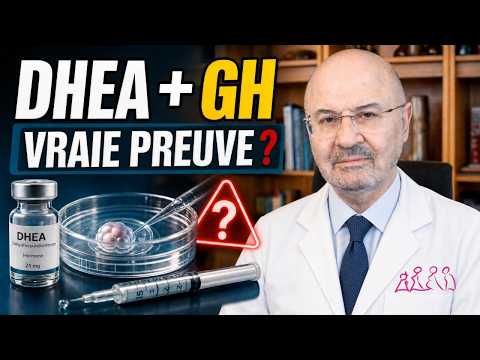
(Note: This video was recorded in French. English and Arabic audio tracks are available in the YouTube player settings.)
What are DHEA and Growth Hormone in IVF?
DHEA and Growth Hormone have been studied as experimental adjuvant therapies before or during ovarian stimulation. The proposed rationale is to influence follicle development, but a biological explanation does not establish a meaningful clinical benefit.
- DHEA (Dehydroepiandrosterone): An androgenic steroid pro-hormone produced by the adrenal glands and ovaries. It can be converted into active androgens; the proposed effect on early follicles remains a biological hypothesis rather than proof of improved live birth.
- Growth Hormone (GH): Acts directly and through Insulin-like Growth Factor 1 (IGF-1). Proposed effects on granulosa-cell responsiveness and follicular development have not established a reliable improvement in live birth.
Does DHEA improve IVF success rates?
DHEA has not shown a clear improvement in live birth in well-conducted trials, even though some studies report a small numerical change in retrieved oocytes.
A comprehensive 2024 Cochrane Systematic Review (Naik et al.) included 28 randomized controlled trials of DHEA or testosterone. For DHEA versus placebo or no treatment, it found little to no difference in live birth or ongoing pregnancy (9 trials, 1,433 women; OR 1.30, 95% CI 0.95–1.76; moderate-certainty evidence). After trials at high risk of bias were excluded, the estimate was 1.08 (95% CI 0.75–1.54; 6 trials, 1,127 women). Because the confidence interval still crosses no effect, this analysis does not show a clear clinical benefit.
Claims that DHEA reduces embryo aneuploidy (chromosomal errors) came from retrospective, case-control comparisons of miscarriage rates (Gleicher et al., 2009) and have not been shown in randomized trials; the Cochrane review found that DHEA probably does not reduce miscarriage.
Does Growth Hormone (GH) help poor responders?
Some studies of Growth Hormone have reported changes in stimulation dose or timing, but these intermediate differences have not translated into a clear live-birth benefit for low responders.
The double-blind, placebo-controlled LIGHT trial (Norman et al., 2019) found a live birth rate of 14.5% (9/62) with GH versus 13.7% (7/51) with placebo, a difference that was not statistically significant. The trial stopped before reaching its planned number of participants, so its wide confidence interval cannot rule out a small effect in either direction.
For DHEA and growth hormone specifically, this review by Conforti et al. did not establish a clear live-birth benefit. It did find a live-birth signal for testosterone, as did the 2024 Cochrane review (8 trials, 716 women; moderate-certainty evidence), but that result does not make testosterone a routine treatment; current ESHRE guidance says testosterone is probably not recommended for low responders.
Comparing DHEA vs. Growth Hormone
The following table summarizes the comparative clinical evidence for DHEA and Growth Hormone:
| Clinical Parameter | DHEA | Growth Hormone (GH) |
|---|---|---|
| Live-birth outcome | No clear benefit shown in current randomized evidence | No clear benefit shown in the LIGHT trial or current guidance |
| Current evidence status | ESHRE: not recommended for low responders | ESHRE says GH is probably not recommended for low responders |
| How to interpret secondary findings | Changes in egg numbers do not establish a live-birth benefit | Changes in stimulation measures do not establish a live-birth benefit |
Side effects and safety considerations
Both substances are active hormonal agents. Their risks, interactions and suitability should be reviewed with the treating clinician:
- DHEA risks: DHEA can cause androgenic effects such as acne, oily skin, hair loss, unwanted hair growth, dizziness and deepening of the voice (HFEA). Evidence about metabolic and longer-term safety in IVF is limited. Androgen supplementation is generally stopped when stimulation starts or, at the latest, before embryo transfer; do not start or continue it during pregnancy without medical advice.
- Growth Hormone risks: GH can cause fluid retention, joint symptoms and changes in glucose tolerance. Its use in reproductive medicine is off-label in many settings, so the decision should be individualized, especially when glucose regulation is a concern.
Professional guidelines (ESHRE, ASRM, HFEA)
Major international reproductive medicine bodies advise against the routine prescription of these adjuvants:
- ESHRE 2025 update: DHEA is not recommended for low responders; GH is probably not recommended for low responders. The terminology has shifted from “poor response” to “low response” in the updated guideline.
- ASRM Practice Committee: The 2018 guideline focuses on mild versus conventional ovarian stimulation for poor responders. It should not be presented as direct evidence that DHEA or GH should be used routinely.
- HFEA (UK): On its androgen-supplementation page, DHEA is rated black for live birth and egg number in women with poor ovarian response or diminished ovarian reserve, meaning the reviewed evidence shows no effect on those outcomes. The same page rates testosterone grey because evidence is insufficient, and it does not rate GH.
Dr. Aksoy’s Approach: Identifying Bottlenecks Instead of Stacking Adjuvants
Related Reading
- Antioxidants & Supplements for Oocyte Quality (CoQ10, Melatonin, NAC)
- How Many Eggs Do You Need for IVF Success?
- Fresh vs. Frozen Embryo Transfer: Clinical Evidence
Frequently Asked Questions for Dr. Aksoy
Does DHEA help you get pregnant or improve egg quality?
DHEA has been used for a long time, especially in women with low ovarian reserve, and some older studies reported more eggs or better embryo results. However, higher-quality randomised trials and recent meta-analyses have not shown that it meaningfully increases the live birth rate. For this reason, the 2025 ESHRE guideline does not recommend DHEA, even for low responders. Personal experiences such as “I took 25–75 mg and got pregnant” can be valuable, but they do not show that the medicine caused the pregnancy; in IVF, results already vary considerably from one cycle to the next without any add-on treatment.
For reference, the 2024 Cochrane review found little to no difference in live birth or ongoing pregnancy with DHEA compared with placebo or no treatment (9 trials, 1,433 women; OR 1.30, 95% CI 0.95–1.76) (Naik et al., 2024), and ESHRE states that DHEA “is not recommended for low responders” (ESHRE 2025).
Can DHEA be taken during a period or during pregnancy, and when should it be stopped?
DHEA is not a medicine taken only at a particular point in the menstrual cycle; in studies it was usually given every day regardless of the cycle and continued during stimulation. This use is, however, off-label and not routinely recommended. DHEA should not be used once a pregnancy has started: it has androgenic effects and its safety in pregnancy has not been shown. If it has been started for IVF, the doctor managing the treatment should decide when to continue and when to stop it, and it should not be continued in pregnancy.
In the trials reviewed by Cochrane, DHEA was started before IVF and, where reported, continued until the end of ovarian stimulation (Naik et al., 2024); the HFEA notes that androgen supplementation is generally stopped when ovarian stimulation starts or at least before embryo transfer (HFEA).
How long does DHEA take to work, and how long before IVF is it started?
In studies, DHEA was most often started about 12 weeks before IVF, usually at 75 mg a day. However, we cannot conclude from this that “DHEA needs three months to work”. These periods come from research protocols, and current data do not show that this preparation increases live births. So, today there is no evidence-based recommendation that everyone should start DHEA three months before IVF.
The study protocols varied: in the Cochrane review two trials gave DHEA for 8 weeks, six for 12 weeks and one for 16 weeks, and most used a daily oral dose of 75 mg (Naik et al., 2024).
Sources
- Naik S, Lepine S, Nagels HE, Siristatidis CS, Kroon B, McDowell S. Androgens (dehydroepiandrosterone or testosterone) for women undergoing assisted reproduction. Cochrane Database of Systematic Reviews 2024;6(6):CD009749.
- Norman RJ, Alvino H, Hull LM, et al. Human growth hormone for poor responders: a randomized placebo-controlled trial provides no evidence for improved live birth rate. Reproductive BioMedicine Online 2019;38(6):908–915.
- Conforti A, et al. Therapeutic management in women with a diminished ovarian reserve: a systematic review and meta-analysis of randomized controlled trials. Fertility and Sterility 2025;123(3):457–476.
- European Society of Human Reproduction and Embryology (ESHRE). ESHRE guideline: ovarian stimulation for IVF/ICSI: an update in 2025. Human Reproduction 2026;41(4):498–514.
- Gleicher N, Ryan E, Weghofer A, Blanco-Mejia S, Barad DH. Miscarriage rates after dehydroepiandrosterone (DHEA) supplementation in women with diminished ovarian reserve: a case control study. Reproductive Biology and Endocrinology 2009;7:108.
- Human Fertilisation and Embryology Authority (HFEA). Androgen supplementation.
- Practice Committee of the American Society for Reproductive Medicine (ASRM). Comparison of pregnancy rates for poor responders using IVF with mild ovarian stimulation versus conventional IVF: a guideline. Fertility and Sterility 2018;109(6):993–999.
Add as a Preferred Source on Google
You can add draksoyivf.com as one of your preferred health information sources on Google.

The content has been created by Dr. Senai Aksoy and medically approved.