
Fibroids and IVF: When Fibroids Matter and When They Do Not
Key Takeaways
Fibroids do not affect IVF in the same way across all patients; the main questions are whether they distort the uterine cavity, complicate egg retrieval, or interfere with implantation. Treatment decisions depend more on size and location than on the fibroid diagnosis alone.
Key evidence: ASRM guideline on removal of myomas to improve fertility (2017) Purohit P, Vigneswaran K. Fibroids and infertility. Best Pract Res Clin Obstet Gynaecol. 2016 Comparison of national and international guidelines on uterine leiomyomas and infertility (2024)
On this page
- Fibroids and IVF
- Which fibroids matter most for IVF?
- How fibroids can affect IVF
- When surgery may help
- Which procedures are used?
- Questions to ask before IVF
- FAQ
- Sources
Fibroids and IVF
Fibroids are common, and many women with them still go on to have healthy pregnancies — naturally or through IVF. If you have just seen the word “fibroid” on your scan report, the useful question is rarely “is it a problem?” The more helpful questions are: where is it, how big is it, and does it distort the cavity or get in the way of treatment?
Two women with the same diagnosis can receive very different advice. A small fibroid sitting in the outer wall of the uterus may barely matter for IVF. A submucosal fibroid pushing into the cavity can have a far clearer effect on implantation or miscarriage risk.
Which Fibroids Matter Most for IVF?
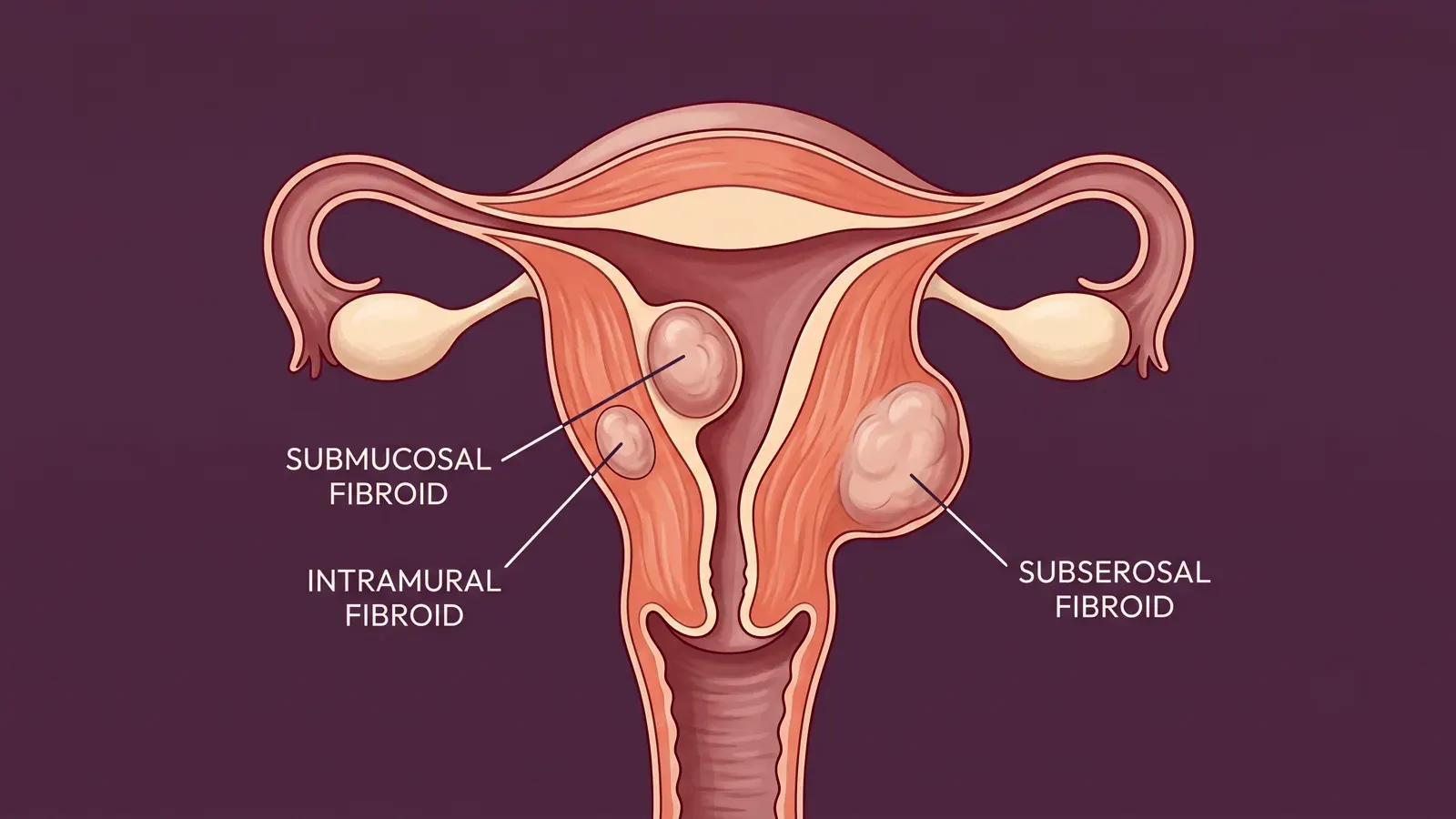
Fibroids are often grouped by location:
- Submucosal fibroids grow into the uterine cavity.
- Intramural fibroids grow within the muscular wall of the uterus.
- Subserosal fibroids grow toward the outer surface of the uterus.
From a fertility perspective, submucosal fibroids usually matter most for your chances because they can distort the cavity where implantation happens (Purohit & Vigneswaran 2016). Intramural fibroids may also matter when they are large, multiple, or clearly change the shape of the cavity. Subserosal fibroids often have less direct effect on your outcome unless they become very large or make treatment technically difficult.
How Fibroids Can Affect IVF
Here is what fibroids can do during an IVF cycle:
- distort the endometrial cavity
- make embryo implantation less efficient
- alter uterine blood flow in some cases
- make egg retrieval harder if ovarian access is blocked
- add bleeding, pain, or bulk symptoms that complicate treatment planning
For you, this does not mean every fibroid needs surgery before IVF. It means fibroids should be evaluated in context — with ultrasound, and sometimes saline sonography or MRI when the anatomy is unclear. When a cavity-distorting fibroid is removed, this may improve your chances of a successful cycle; the evidence that it reduces miscarriage risk is more limited. Either way, the decision is yours, made with your team (ASRM 2017).
When Surgery May Help
Surgery is more often considered when:
- a fibroid clearly distorts the uterine cavity
- repeated implantation failure raises concern about uterine factors
- the fibroid is large enough to block access during retrieval
- heavy bleeding, pressure, or pain are already significant problems
- imaging suggests the endometrial contour is abnormal
Dr. Aksoy’s Approach: The question I ask in clinic is never “does she have a fibroid?” — it is “what is this fibroid doing to the cavity?” A 4 cm fibroid growing outward and a 4 cm fibroid bulging into the cavity are different problems, even though the scan reports the same number. That distinction is usually what decides whether surgery actually helps before IVF (ASRM 2017).
The goal is not to remove every fibroid at any cost. The goal is to improve your uterine environment when the expected fertility benefit outweighs the surgical burden, and guidelines differ in how strongly they support surgery depending on fibroid type and cavity involvement (guideline comparison 2024). For patients planning IVF treatment in Istanbul from abroad, deciding whether a fibroid needs treatment first is part of preparing the cycle before travel.
Which Procedures Are Used?
The procedure depends mainly on fibroid location.
Hysteroscopic Resection
If a fibroid protrudes into the cavity, hysteroscopy is often the preferred approach. The surgeon passes a thin camera through the cervix and removes the cavity-distorting tissue without abdominal incisions.
Laparoscopic Myomectomy
For selected intramural or subserosal fibroids, laparoscopic myomectomy may be used. This can reduce recovery time compared with open surgery, but it is not the right option for every patient.
Open Surgery
Open myomectomy may still be needed when fibroids are very large, numerous, or positioned in a way that makes minimally invasive surgery unrealistic or unsafe.
Questions to Ask Before IVF
When fibroids are found before IVF, useful questions include:
- Does the fibroid distort the cavity?
- Could it interfere with embryo transfer or implantation?
- Could it make egg retrieval technically difficult?
- Is surgery likely to improve outcome enough to justify the delay?
- How long should I wait after surgery before starting treatment?
Bring these questions to your appointment. They turn a vague worry into a concrete plan — and they are far more useful than treating a fibroid as a simple yes-or-no diagnosis.
Related Reading
- Adenomyosis and IVF: When It Matters and How Treatment Is Tailored
- Limits of Laparoscopic Myomectomy
- Uterine Polyps: Symptoms, Diagnosis, and When They Matter for Fertility
FAQ
Do all fibroids lower IVF success?
No. Many fibroids do not meaningfully affect IVF, especially when they are small and do not distort the uterine cavity.
Which fibroids are most important for implantation?
Submucosal fibroids are usually the most relevant because they push into the uterine cavity and can directly interfere with implantation.
Should every fibroid be removed before IVF?
No. Surgery should be individualized. Removing a fibroid only makes sense when the likely benefit is greater than the surgical risk, cost, and treatment delay.
How long should I wait after myomectomy before starting IVF?
There is no universally established minimum interval; data on precise timing after myomectomy are limited and recommendations vary. The right timing is decided with your team, based on the type of surgery, uterine healing, and your situation.
Can fibroids make egg retrieval difficult?
Yes, in some cases. Large fibroids or distorted pelvic anatomy can make it harder to reach the ovaries safely during retrieval.
Can IVF still work if I have fibroids?
Yes. Many patients with fibroids still have successful IVF cycles. The outcome depends more on fibroid size, location, cavity involvement, age, embryo factors, and the rest of the fertility picture.
Sources
- American Society for Reproductive Medicine. Removal of myomas in asymptomatic patients to improve fertility and/or reduce miscarriage rate: a guideline (2017).
- Purohit P, Vigneswaran K. Fibroids and infertility.
- Uterine Leiomyomas and Infertility. A comparison of national and international guidelines.
Add as a Preferred Source on Google
You can add draksoyivf.com as one of your preferred health information sources on Google.

The content has been created by Dr. Senai Aksoy and medically approved.