
Treating Endometriosis Pain: Medical and Supportive Options
Key Takeaways
Endometriosis pain treatment is individualised rather than fixed to one universal ladder. Analgesics and hormonal treatments are common options; GnRH therapies and aromatase inhibitors are considered in selected situations. Pelvic floor physiotherapy, psychological support or other non-medical approaches may be discussed, but evidence is not strong enough to present one as an established endometriosis treatment. Pregnancy plans should be part of the decision from the start.
Key evidence: ESHRE Guideline: Endometriosis (2022) Dienogest vs Leuprolide Trial (Strowitzki et al., 2010) NICE Guideline: Endometriosis Diagnosis and Management (NG73)
Why treatment needs to be individualised
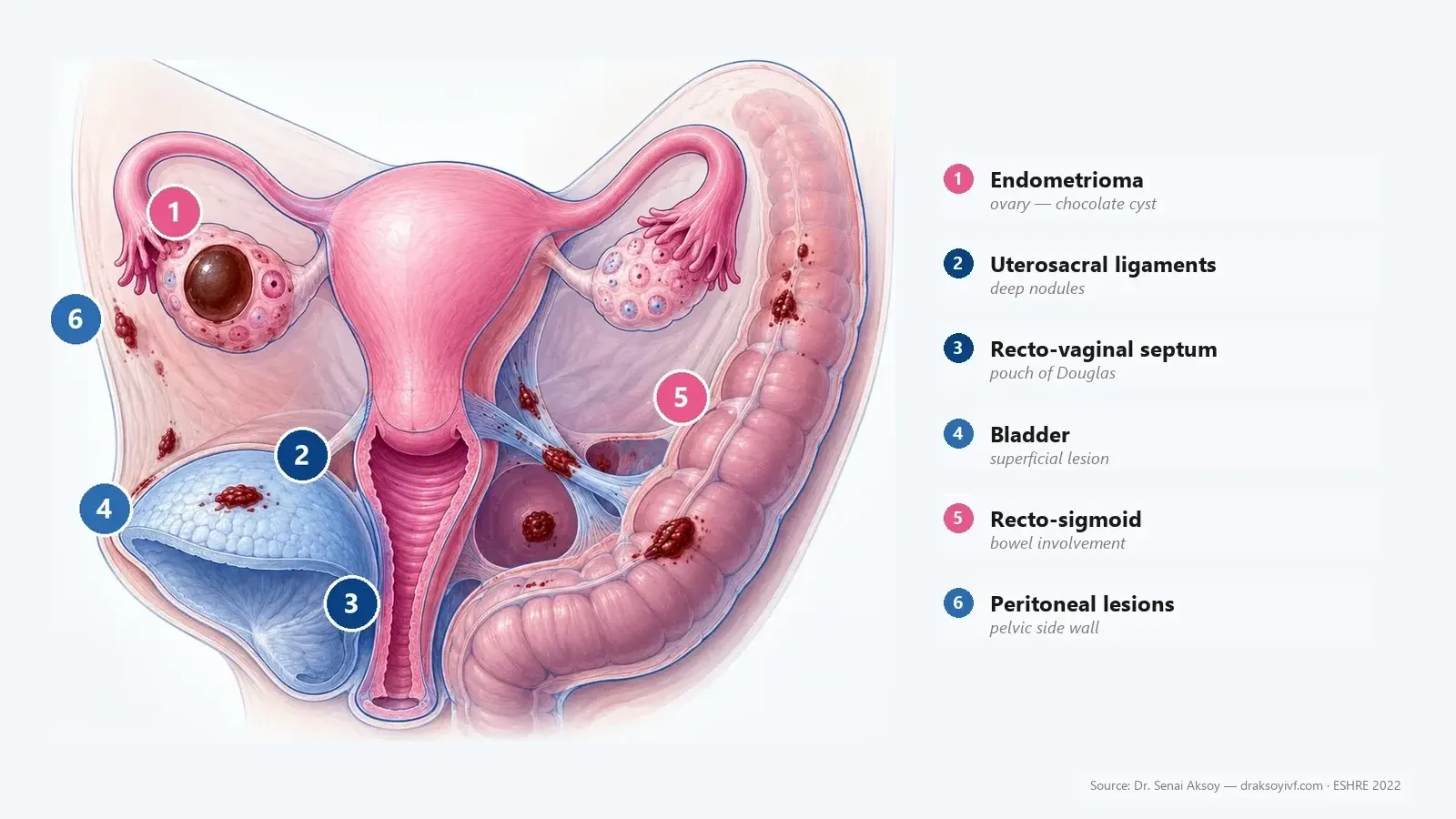
Endometriosis pain does not have a single cause. Inflammation, adhesions or deep disease, changes in pain processing, and tension in the pelvic floor muscles may all contribute. Their importance differs from one person to another.
Because no single treatment addresses every contributor, the ESHRE 2022 guideline presents analgesics, hormonal treatment and surgery as options to discuss through shared decision-making. Care may be adjusted step by step, but there is no single ladder that fits everyone.
The choice usually depends on four practical considerations:
- Pain severity and characteristics: progressive dysmenorrhoea, non-cyclic chronic pelvic pain, deep dyspareunia, or cyclic bowel and bladder pain.
- Pregnancy plans: hormonal treatments that suppress ovulation are not used during active attempts to conceive.
- Individual tolerability: bleeding pattern acceptance, mood stability, and metabolic or bone profiles.
- Medical comorbidities: thromboembolic risk factors, migraine with aura, blood pressure, and bone mineral density.
Your doctor determines the exact medication, dosage, and duration best suited to your needs. For a broader overview of the condition, consult our complete endometriosis guide, our guide on diagnosing endometriosis, and endometriosis symptoms.
Analgesics and combined hormonal contraceptives
Non-steroidal anti-inflammatory drugs (NSAIDs)
NSAIDs (such as ibuprofen or mefenamic acid) are used on-demand during acute painful episodes.
They reduce prostaglandin production, which can help with period-related pain.
They can help with symptoms, but regular or high-dose use carries gastrointestinal, kidney and cardiovascular risks. They do not treat every source of pelvic pain, so persistent symptoms need reassessment.
Combined hormonal contraceptives (CHC)
The ESHRE 2022 guideline recommends combined hormonal contraceptives as one hormonal option for reducing endometriosis-related pain:
- Delivery routes: combined oral contraceptive pills, transdermal patches, or vaginal rings.
- Continuous or extended regimens: continuous use can be considered, particularly when period pain or withdrawal bleeding is a major problem.
- Possible benefits: these treatments may reduce period pain, non-menstrual pelvic pain and pain during sex.
Oestrogen-containing treatment is not suitable for everyone. A clinician should review thromboembolic history, migraine with aura, blood pressure, smoking and other cardiovascular risk factors before prescribing it.
Progestogens
Dienogest 2 mg daily
Dienogest is an oral progestogen used to treat endometriosis-related pain.
In a 24-week randomised open-label trial involving 252 women, dienogest reduced pain to a similar degree as leuprolide acetate. Mean lumbar bone mineral density changed by +0.25% with dienogest and -4.04% with leuprolide in the measured subgroups (Strowitzki et al., 2010). These results apply to the treatments and duration studied; they do not establish equivalence between every progestogen and every GnRH therapy.
Irregular bleeding or spotting is common, especially early in treatment, and amenorrhoea may occur. Weight or mood changes are also reported by some people. What is acceptable varies, so side effects should be reviewed rather than simply endured.
Alternative progestin options
- Levonorgestrel-releasing intrauterine system (LNG-IUS): delivers levonorgestrel inside the uterus and is recommended by ESHRE as an option for reducing endometriosis-related pain. It may suit someone who also wants contraception or finds daily tablets difficult.
- Etonogestrel subdermal implant: provides continuous progestin-only suppression for three years without systemic oestrogen.
- Oral progestins: norethisterone acetate or medroxyprogesterone acetate, tailored according to clinical context and patient tolerance.
The choice among these progestin modalities depends on bleeding preferences, contraceptive needs, tolerability, and treatment compliance.
GnRH agonists and add-back treatment
GnRH agonists (such as leuprolide, triptorelin, goserelin, or nafarelin) downregulate the pituitary-ovarian axis, creating a temporary, reversible hypooestrogenic state that deprives endometriotic implants of oestrogenic stimulation.
GnRH agonists can reduce pain, but the resulting low-oestrogen state may cause hot flushes, night sweats, vaginal dryness, mood changes and loss of bone mineral density.
Important points to discuss include:
- Place in treatment: ESHRE recommends considering GnRH agonists as a second-line option because of their side-effect profile.
- Add-back treatment: combined hormonal add-back should be considered to reduce low-oestrogen symptoms and bone loss. The choice and timing depend on the medicine, contraindications and local prescribing guidance.
- Duration: there is no single course length for every patient. It depends on the product, response, add-back regimen and risk profile.
- Bone health: bone-density assessment may be appropriate when treatment is prolonged or osteoporosis risk factors are present.
Aromatase inhibitors: a niche option
Aromatase inhibitors such as letrozole or anastrozole reduce oestrogen production. ESHRE recommends them only for pain that remains refractory to other medical or surgical treatment.
- After menopause: use may be discussed case by case by a specialist because evidence is limited.
- During reproductive years: they are combined with treatment that suppresses ovarian stimulation, such as a progestogen, combined contraceptive, GnRH agonist or GnRH antagonist.
This treatment remains off-label in many jurisdictions and is used for complex, refractory cases under specialist supervision.
Integrative and multidisciplinary approaches
Living with persistent pain may require support beyond medication. ESHRE advises discussing non-medical strategies for quality of life and wellbeing, but the evidence does not support recommending one specific intervention as an established endometriosis treatment.
Pelvic floor physiotherapy
Pelvic floor physiotherapy may be considered when examination suggests muscle overactivity, tenderness or poor coordination. A specialist physiotherapist can adapt techniques such as relaxation, manual treatment or biofeedback to the findings. This is a targeted approach to a muscular component of pain, not a treatment for endometriosis lesions themselves.
Cognitive behavioural therapy (CBT)
CBT may offer practical tools for coping with chronic pain, anxiety or sleep disruption. It can complement medical assessment, but evidence is not strong enough to present it as a specific treatment for endometriosis.
Acupuncture
Evidence for acupuncture remains limited and does not support presenting it as a standard treatment. If chosen, it should remain an adjunct and should not delay medical assessment.
Nutrition and dietary patterns
No specific diet has been shown reliably to treat endometriosis lesions or pain. A balanced diet may support general health and digestive comfort. Supplements should be discussed in relation to diet, documented deficiencies, possible interactions and individual health needs; they do not replace medical care.
Special case: adolescents
Endometriosis symptoms can begin around the first periods. A normal ultrasound does not rule out the condition, particularly superficial disease, and persistent symptoms still deserve assessment.
Disabling dysmenorrhoea that leads to recurring school absenteeism, emergency room visits, or failure to respond to over-the-counter pain medications warrants early clinical evaluation.
The ESHRE 2022 guidelines provide clear recommendations for adolescents:
- Hormonal treatment: hormonal contraceptives or progestogens can be offered as first-line hormonal therapy after considering preferences and side effects.
- Laparoscopy: if imaging is negative and medical treatment has not been effective, diagnostic laparoscopy may be considered in an experienced centre.
- Holistic support: psychological, educational, and family support to address the impact of chronic pain early in life.
Dr. Aksoy’s clinical perspective
Dr. Aksoy’s Approach: Balancing Pain Relief with Fertility Goals
“When treating disabling endometriosis pain, pain intensity is not the only factor that guides the plan. I also look closely at possible organ involvement and the timing of pregnancy plans.
Hormonal treatments that suppress ovulation—including combined contraceptives, dienogest and GnRH agonists—are not used while a patient is actively trying to conceive. That timing changes the conversation.
If pregnancy is the immediate goal, we discuss a fertility assessment suited to the couple’s age, history and how long they have been trying. The next step may involve expectant management, surgery or assisted conception; it is not automatically the same for everyone. Hormonal treatment alone does not improve spontaneous pregnancy rates while someone is trying to conceive.
If pregnancy is not planned in the near term, medical options can be adjusted according to response and preference. Pelvic floor physiotherapy may be useful when examination identifies a muscular component. If a GnRH agonist is needed, add-back treatment should be discussed from the start according to the medicine and the patient’s risk profile.
Surgery is not an automatic first step for pain. It should be discussed when symptoms persist, deep disease affects an organ, or fertility considerations change the balance, with the benefits, risks and alternatives made clear.”
— Dr. Senai Aksoy
In practice
- Common early options: Analgesics as needed and/or hormonal treatment, chosen according to symptoms, preferences and contraindications.
- Progestogen options: Dienogest, LNG-IUS, an implant or another progestogen may be considered according to bleeding preferences, contraceptive needs and side effects.
- Further medical options: GnRH treatment may be considered when earlier options are ineffective or unsuitable, with add-back and duration discussed individually.
- Aromatase inhibitors: Niche, specialist option for complex refractory disease.
- Supportive care: Pelvic floor physiotherapy or psychological support may be discussed when a muscular or chronic-pain component is identified; neither replaces medical assessment.
- Individualisation: Every plan should reflect pregnancy goals, treatment safety, side effects and daily functioning.
FAQ
What is the recommended first-line treatment for endometriosis pain?
NSAIDs can be offered for pain, either alone or with another treatment. For hormonal treatment, a combined contraceptive is one option; continuous use can be considered when period pain is prominent. The choice depends on symptoms, preferences and contraindications.
Does dienogest cause weight gain?
Weight changes are reported by some people, but they are not inevitable. Irregular bleeding is common, especially early in treatment, and may improve, persist or develop into amenorrhoea. Discuss troublesome effects rather than assuming they will settle.
Do GnRH agonists cause permanent bone loss?
GnRH agonists can reduce bone mineral density because they lower oestrogen. Add-back treatment can reduce bone loss and low-oestrogen symptoms, but the regimen, timing, duration and need for bone monitoring should be individualised.
Can I become pregnant while taking medical treatments for endometriosis?
Hormonal treatments that suppress ovulation are not used during active attempts to conceive. If pregnancy is your goal, discuss when and how to stop or change treatment with your clinician rather than making the change alone. NICE notes that hormonal treatment does not have a permanent negative effect on later fertility.
Can diet alone cure endometriosis pain?
No specific diet has been shown to remove endometriosis lesions or replace medical treatment. A balanced eating pattern may support general health and digestive comfort.
Why is pelvic floor physiotherapy recommended?
Some people with endometriosis also have pelvic floor muscle tenderness, overactivity or poor coordination. Specialist physiotherapy may help that muscular component after an appropriate assessment; it does not treat the lesions themselves.
What happens if medical therapies fail?
If medication does not provide acceptable relief, specialist review can revisit the diagnosis and discuss other options, including laparoscopy. The decision depends on symptoms, disease location, pregnancy plans, surgical risks and the available alternatives.
Sources
- Becker CM, Bokor A, Heikinheimo O, et al. ESHRE guideline: endometriosis. Human Reproduction Open 2022;2022(2):hoac009.
- Strowitzki T, Marr J, Gerlinger C, et al. Dienogest is as effective as leuprolide acetate in treating the painful symptoms of endometriosis: a 24-week, randomized, multicentre, open-label trial. Hum Reprod 2010;25(3):633–641.
- National Institute for Health and Care Excellence (NICE). Endometriosis: diagnosis and management (NG73). Updated 2024.
- World Health Organization (WHO). Endometriosis Fact Sheet. 2025.
- Guerriero S, Condous G, van den Bosch T, et al. Systematic approach to sonographic evaluation of the pelvis in women with suspected endometriosis: IDEA consensus opinion. Ultrasound Obstet Gynecol 2016;48(3):318–332.
Add as a Preferred Source on Google
You can add draksoyivf.com as one of your preferred health information sources on Google.

The content has been created by Dr. Senai Aksoy and medically approved.