
Endometriosis surgery: excision, deep disease and ovary-sparing techniques
Key Takeaways
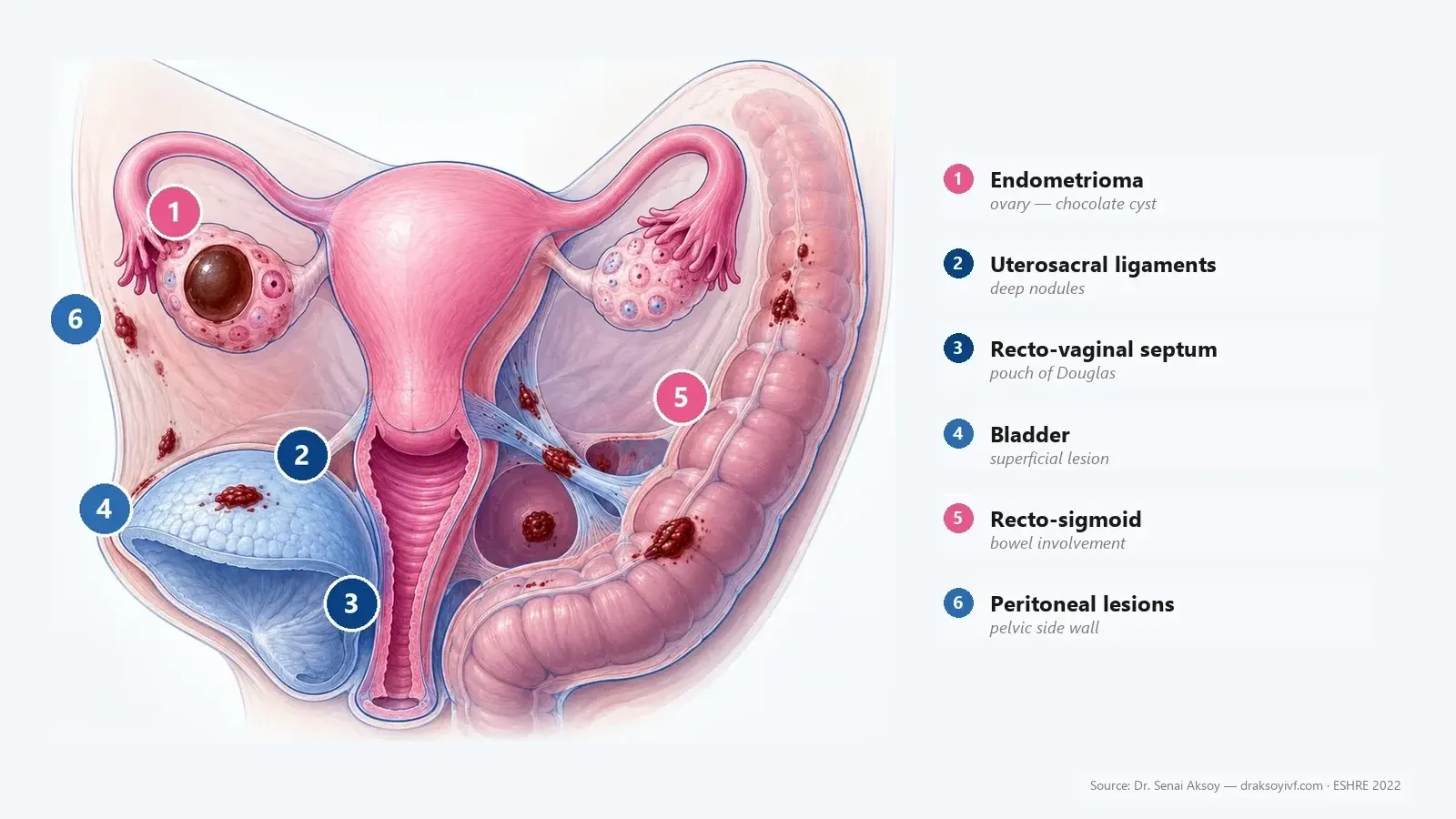
For superficial endometriosis lesions, excision is preferred over thermal ablation (Pundir 2017, Healey 2014). Deep infiltrating endometriosis (rectum, sigmoid, ureters, bladder) should be managed in expert centres with multidisciplinary teams; bowel-sparing techniques (shaving, discoid excision) have markedly fewer complications than segmental resection (Bendifallah 2020). Recurrence is estimated at 21.5 % at 2 years and 40–50 % at 5 years without post-operative medical therapy and is significantly reduced by maintenance hormonal treatment.
Key evidence: ESHRE guideline: endometriosis (2022) Bendifallah et al. 2020 — bowel-sparing techniques meta-analysis
On this page
- Why operate — and why not routinely
- Superficial lesions: excision over ablation
- Deep endometriosis: multidisciplinary team
- Bowel-sparing techniques
- Urinary tract involvement
- Diaphragmatic and thoracic endometriosis
- Choice of surgical energy
- Ovarian preservation techniques
- Surgical risks to keep in mind
- Recurrence and prevention
- Surgery and fertility
- In practice
- FAQ
Why operate — and why not routinely
Surgery is no longer mandatory for every patient with endometriosis. Modern care relies on medical management and high-resolution imaging first.
Per ESHRE 2022 guidelines, surgery is indicated for:
- Refractory pain: Severe pain failing medical therapy.
- Deep Infiltrating Endometriosis (DIE): Bowel, bladder, ureteral, or rectovaginal septum lesions.
- Symptomatic endometriomas: Cysts causing pain or posing a technical obstacle to egg retrieval.
- Severe anatomical distortion: Extensive pelvic adhesions.
Surgery should not be performed as a routine diagnostic step or prior to IVF without specific clinical indications.
Superficial lesions: excision over ablation
For superficial peritoneal disease, surgical excision removes the lesion with its base. Ablation burns the surface.
Excision is preferred in the evidence cited below.
- Pain relief: Pundir et al. (2017) showed excision provides superior 12-month relief for chronic pelvic pain and dyschezia.
- Long-term outcomes: Healey et al. (2014) documented reduced 5-year pain recurrence and lower need for post-op hormonal therapy.
- Histological verification: Excision provides tissue samples for pathological diagnosis.
Deep endometriosis: multidisciplinary team
Deep infiltrating endometriosis (DIE) penetrates more than 5 mm into organ walls. It often needs more than one surgical specialty.
Effective care requires specialized multidisciplinary centers providing:
- Pre-operative mapping: High-resolution IDEA ultrasound and pelvic MRI.
- Surgical team: Gynecologic, colorectal, and urologic surgeons working together.
- Standardized classification: Precise mapping using the #Enzian classification system.
Bowel-sparing techniques
For rectosigmoid involvement, conservative bowel-sparing techniques are preferred whenever clinically feasible.
Surgical options:
- Shaving: Superficial excision of the lesion off the muscularis layer without opening the bowel.
- Discoid excision: Full-thickness excision of a small bowel wall disc followed by primary closure.
- Segmental resection: Complete removal of a bowel segment with end-to-end anastomosis.
The Bendifallah et al. (2020) meta-analysis found that rectal shaving has significantly fewer complications than segmental resection.
Rectovaginal fistulas and anastomotic leaks were less common, while pain relief was equivalent.
Urinary tract involvement
- Bladder disease: Treated with partial cystectomy or discoid excision followed by temporary catheterization.
- Ureteral disease: Managed with ureterolysis (freeing the ureter) or segmental ureteral resection with reimplantation for intrinsic lesions.
Diaphragmatic and thoracic endometriosis
Rare presentations can cause cyclic shoulder pain or catamenial pneumothorax. The latter is a lung collapse during menstruation.
Thoracic and gynaecologic surgeons manage these cases together.
Choice of surgical energy
Surgeons select energy modalities based on anatomical location:
- Bipolar & Plasma Energy: Preferred near ovaries to minimize thermal damage to healthy eggs.
- CO₂ Laser: Sub-millimetric precision ideal for superficial peritoneal implants.
- Monopolar & Ultrasonic: Used for pelvic sidewall dissection and colorectal cases.
Ovarian preservation techniques
To protect ovarian reserve during endometrioma surgery:
- Plasma ablation: Preserves AMH levels better than capsule stripping (Hurni et al. 2025).
- Suture re-approximation: Closing the ovarian bed with fine sutures rather than bipolar cautery preserves follicle counts (Lin et al. 2025).
Surgical risks to keep in mind
- Ovarian reserve reduction: AMH drop following endometrioma excision.
- Fistula formation: Risk of rectovaginal or vesicovaginal fistula.
- Adhesion formation: Post-operative pelvic scar tissue.
Recurrence and prevention
Without suppressive medical therapy, endometrioma recurrence rates reach 21.5% at 2 years and 40–50% at 5 years.
- Prevention: Long-term hormonal suppression (dienogest, continuous oral contraceptives, or LNG-IUS) significantly lowers recurrence risk.
Surgery and fertility
- Superficial disease: Excision modestly improves spontaneous pregnancy rates.
- Endometriomas: Pre-IVF cystectomy is not routinely recommended.
- Low reserve: Ovarian surgery should be avoided if possible; prioritize egg or embryo freezing.
Clinical Note
Seeing endometriosis on imaging does not automatically mean you need surgery. We weigh the decision against three questions:
- Will surgery relieve severe pain?
- Will it protect a vital organ?
- Will it genuinely improve your chance of pregnancy?
Our goal is not to clean up an MRI scan. It is to treat what needs treatment while preserving your organs, ovarian reserve, and future fertility.
Dr. Senai Aksoy
In practice
- Choose excision over ablation for superficial lesions.
- Manage deep disease in specialized multidisciplinary centers.
- Prefer bowel-sparing shaving over segmental resection when possible.
- Avoid routine pre-IVF endometrioma surgery.
- Maintain post-operative hormonal suppression to prevent recurrence.
Request a Case Review
If surgery is being discussed, a review of your imaging, symptoms, and fertility plans can clarify the appropriate technique and timing.
This is more useful than applying a generic protocol. You can request a confidential case review before deciding on surgery.
FAQ
Why prefer excision over ablation?
Randomised studies (Pundir 2017, Healey 2014) show that excision is superior for dyschezia, dyspareunia, chronic pelvic pain, and overall quality-of-life scores.
Excision also provides tissue for histology and limits thermal injury to healthy tissue.
Will I lose part of my bowel during surgery?
Not systematically. Conservative techniques such as shaving and discoid excision are preferred where anatomy allows.
Segmental resection is reserved for extensive, circumferential, or multifocal involvement. The Bendifallah 2020 meta-analysis found fewer complications with shaving.
How long is the recovery after surgery?
For standard laparoscopic surgery of superficial endometriosis, return to normal activities takes 2 to 4 weeks. For DIE surgery with bowel or urological resection, recovery may take 6 to 8 weeks depending on extent.
What is the risk of recurrence after surgery?
Without post-operative medical therapy, recurrence is about 21.5% at 2 years and 40% to 50% at 5 years.
Maintenance hormonal therapy significantly reduces this risk in women without immediate pregnancy plans. Options include a continuous combined contraceptive, dienogest, or an LNG-IUS.
Should surgery be performed to improve fertility?
It depends on stage and context. Excision of superficial lesions may modestly improve the chance of spontaneous pregnancy.
Routine cystectomy of an endometrioma before IVF is not recommended. The decision should reflect EFI, age, ovarian reserve, and associated factors.
How do I choose where to have surgery?
For deep endometriosis, prefer an expert centre with:
- a multidisciplinary team (gynaecology, colorectal surgery, urology);
- sufficient surgical volume (several dozen cases per year);
- dedicated pre-operative imaging (IDEA ultrasound + MRI);
- an outcomes-assessment process.
Is there an alternative to surgery?
Yes. Stepped medical treatment is effective for most pain and should be tried before purely diagnostic surgery.
Options include combined contraceptives, dienogest, and GnRH agonists with add-back. Surgery remains indicated for refractory pain, symptomatic deep endometriosis, or complications.
Sources
- Becker CM, Bokor A, Heikinheimo O, et al. ESHRE guideline: endometriosis. Human Reproduction Open 2022;2022(2):hoac009.
- Pundir J, Omanwa K, Kovoor E, et al. Laparoscopic Excision Versus Ablation for Endometriosis-associated Pain: An Updated Systematic Review and Meta-analysis. J Minim Invasive Gynecol 2017;24(5):747–756.
- Healey M, Cheng C, Kaur H. To excise or ablate endometriosis? A prospective randomized double-blinded trial after 5-year follow-up. J Minim Invasive Gynecol 2014;21(6):999–1004.
- Bendifallah S, Vesale E, Daraï E, et al. Bowel-sparing techniques versus segmental resection for deep infiltrating colorectal endometriosis: systematic review and meta-analysis. J Minim Invasive Gynecol 2020.
- Keckstein J, Saridogan E, Ulrich UA, et al. The #Enzian classification: A comprehensive non-invasive and surgical description system for endometriosis. Acta Obstet Gynecol Scand 2021;100:1165–1175.
- Hurni Y, La Torre F, Barbany-Freixa N, et al. Plasma energy ablation versus cystectomy in fertility-sparing surgery for endometriomas: impact on recurrence and ovarian reserve. Reprod Biomed Online 2025;52(6):105409.
- Lin C, Chen G, Wang M, et al. Robotic assisted versus conventional laparoscopic ovarian suture reapproximation in ovarian cystectomy of ovarian endometriomas in preserving ovarian reserve. J Robot Surg 2026;20(1):138.
Add as a Preferred Source on Google
You can add draksoyivf.com as one of your preferred health information sources on Google.

The content has been created by Dr. Senai Aksoy and medically approved.